
 26Feb
Immersion cooling for servers: definition & functionality
Immersion cooling is a cooling method for hardware such as servers or storage devices, in which IT components and other electronic equipment are immersed in a non-conductive liquid that directly dissipates heat. Immersion cooling is more efficient than traditional cooling using fans or water.
In immersion cooling, all IT equipment is submerged in a cooling fluid. The hardware is evenly coated from all sides. Heat is dissipated directly at its source. An average immersion-cooled data center consumes almost 50% less energy than data centers with purely air-cooled systems. This was demonstrated in a study by the University of Groningen, which compared air and immersion cooling.
Immersion cooling uses a liquid stream to extract heat via convection, which is then dissipated into the environment through a single-phase or two-phase system. In single-phase immersion cooling systems, the coolant remains liquid throughout the entire cycle. In two-phase systems, the hot liquid evaporates and condenses before flowing back into the system. Immersion cooling allows for significantly higher waste heat temperatures than air cooling, even without heat pumps. According to the data center portal DataCenter-Insider, immersion cooling also improves the quality of the waste heat. When liquid cooling servers, the water heats up to 60 degrees Celsius, making it suitable for use in district heating networks.
Cold and hot aisle containment systems with components from SCS FACO represent a modern and future-proof alternative to immersion cooling for data centers and server rooms. Unlike immersion cooling, where server components are submerged in a liquid coolant to dissipate heat directly, the hot and cold aisle containment systems from SCS FACO, available at serverroom-security.com, utilize energy-efficient airflow to ensure stable temperatures. The cold aisle containment system keeps the cold air where it is needed, ensuring a constant supply of cold air to the servers. The targeted airflow of the SCS FACO hot aisle containment system ensures that the warm air generated by the servers is consistently exhausted through the chimney elements into a suspended ceiling, preventing the mixing of airflows.
This article provides a comprehensive overview of the immersion cooling process. Furthermore, it explains in detail how immersion cooling works, its advantages and disadvantages, and presents alternative cooling systems for servers.
What is immersion cooling for servers?
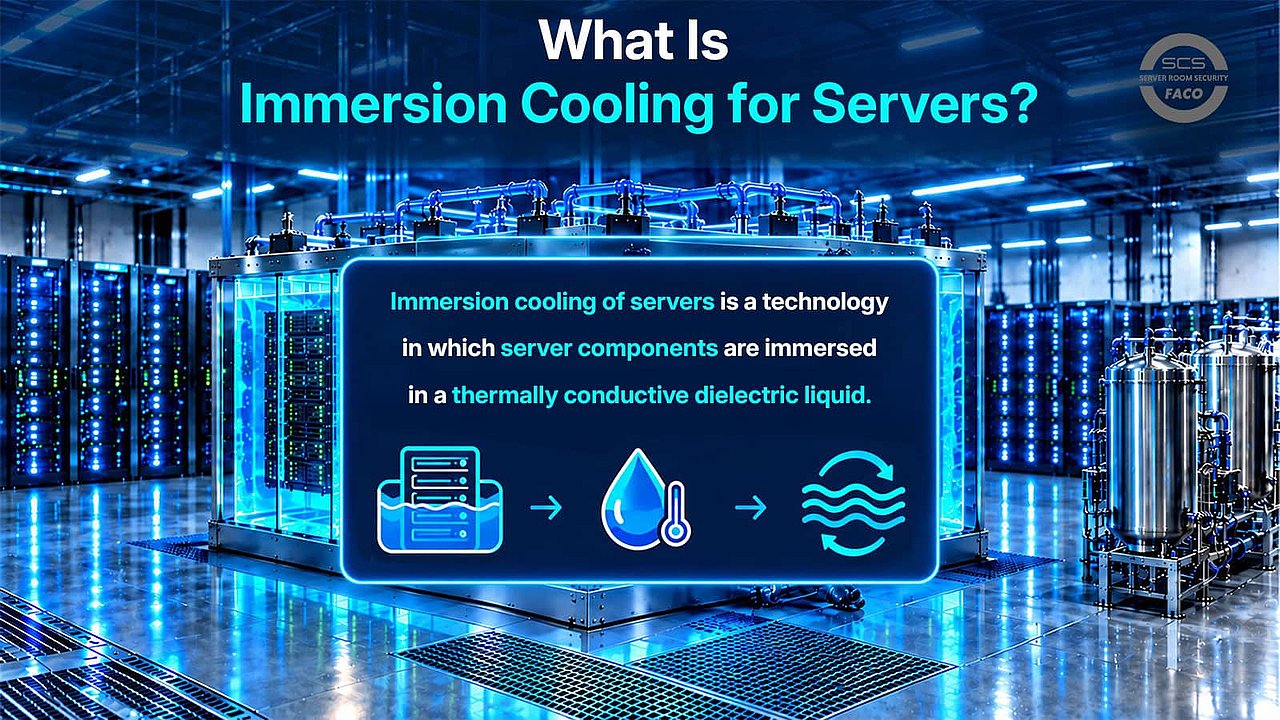
Immersion cooling for servers is a technology in which server components are immersed in a thermally conductive dielectric fluid to efficiently dissipate heat. Immersion-cooled servers consume almost 50% less energy than purely air-cooled servers, according to a study by the University of Groningen.
There are two types of immersion cooling. In single-phase immersion cooling, the coolant does not change its state of matter. In two-phase immersion cooling, the coolant exists in different states. The heat generated by the hardware causes the coolant to boil and evaporate.
The classic application of immersion cooling is the cooling of servers and data centers. Other applications include battery cooling, AI applications, electric vehicles, and public transportation. This cooling method offers significant advantages, particularly in areas where high computing power and energy efficiency are crucial.
The history of immersion cooling began in the 19th and 20th centuries with the discovery of electromagnetic induction by natural scientist Sir Michael Faraday and physicist Joseph Henry. In 1884, the first closed-core transformer was constructed. Three years later, electrical systems were used in dielectric fluids for cooling. Commercial immersion cooling systems were first introduced in 2009. The first industry standard for immersion cooling systems was presented in 2019.
The way immersion cooling works depends on various components.
How does immersion cooling work in servers?
Immersion cooling in servers works by immersing the hardware in a non-conductive liquid that directly dissipates the heat. The server is evenly coated with the cooling fluid from all sides. Depending on the technology, single-phase or two-phase fluids are used.
The coolant for the immersion cooling system is circulated in a closed loop within a tank. The cold fluid initially sits at the bottom of the tank. As it warms up due to waste heat from the electrical components, it rises. Heat is extracted from the fluid, and it flows back down to the bottom of the tank. This waste heat is then transferred via a heat exchanger and can be used for other purposes.
Immersion cooling encompasses two variants and methods, each requiring different fluids. Immersion cooling can be further divided into single-phase and two-phase methods.
- Single-phase immersion cooling: In single-phase immersion cooling, all server components are immersed in a non-conductive, dielectric fluid to dissipate heat via a heat exchanger. The coolant remains in a liquid state and is not brought to a boil. This method significantly reduces the temperature of computer components compared to air cooling.
- Two-phase immersion cooling: In two-phase immersion cooling, a liquid is used that is brought to a boil by the heat of the components, resulting in a phase change from liquid to gaseous. The resulting vapor rises, condenses on a condenser, and drips back into the liquid. This process increases the efficiency of heat transfer and is often used in high-performance applications.
Immersion cooling offers some advantages, but also has a number of disadvantages.
Advantages and disadvantages of immersion cooling
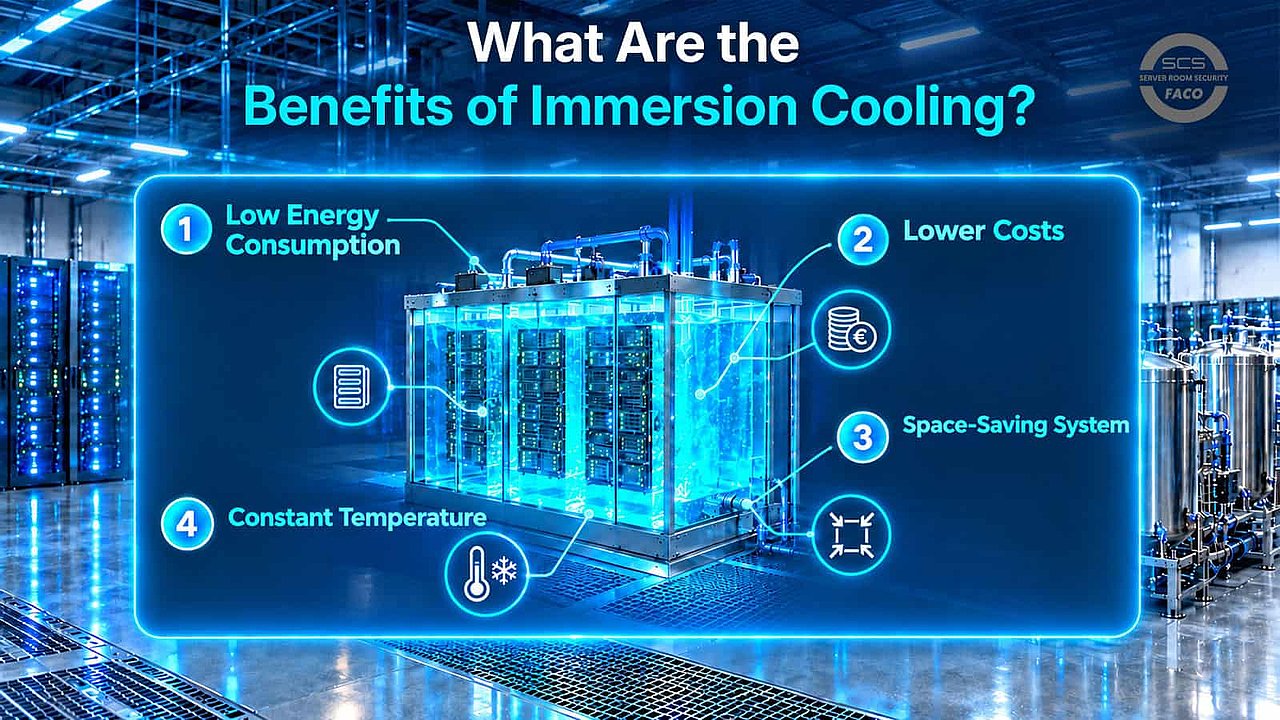
Advantages of immersion cooling include low energy consumption and operating costs, the maintenance of constant temperatures, and space savings. Disadvantages include the complex handling of the fluids, long maintenance times, and costly modifications.
What are the advantages of immersion cooling?
The advantages of immersion cooling include low energy consumption and reduced operating costs. Compared to conventional air cooling, immersion cooling can save up to 40 percent energy. Further advantages include maintaining constant temperatures and saving space during operation.
The most important advantages of immersion cooling are summarized in the following list.
- Low energy consumption: Immersion cooling saves up to 40 percent energy compared to conventional air cooling. Traditional air cooling systems in data centers require a significant amount of energy to operate fans that expel the warm air. With immersion cooling, fans are unnecessary because the heat is dissipated directly by the liquid.
- Lower costs: Immersion cooling is cost-effective because no fans are needed to regulate heat. Conventional cooling technologies require significant space and contribute to higher overall operating costs. The heat absorption of the dielectric immersion fluid allows inefficient air conditioning systems to be throttled without shutting them down. Using immersion cooling in a data center eliminates the need for additional roof cooling and raised floors, thus saving on energy and construction costs.
- Space-saving system: Immersion cooling is an efficient cooling system that requires no complex infrastructure. Conventional cooling methods require a specific layout and significant space for infrastructure. Immersion cooling offers high cooling performance with a small footprint and is particularly suitable for high-power IT components.
- Constant temperature: Immersion cooling maintains a constant and uniform temperature in the server room. The liquid in the cooling system distributes heat evenly and dissipates it into the surrounding environment to prevent overheating and hotspots.
Despite the numerous advantages of immersion cooling, there are also some disadvantages and challenges to consider when implementing this technology.
What are the disadvantages of immersion cooling?
The disadvantages of immersion cooling are the complex handling of the cooling fluids, the high maintenance requirements, and the extensive modifications required before initial commissioning. Before any repair or replacement, the immersion cooling fluid must be completely drained and the system cleaned.
The most important disadvantages of immersion cooling are summarized in the following list.
- Complicated handling: Immersion cooling requires complex usage management. Handling, storing, and disposing of the coolant is complex and time-consuming. The coolant must be completely drained before any repair or replacement.
- Time-consuming modifications: Immersion cooling can only be integrated into an existing server center through extensive modifications. Setting up an immersion cooling system involves special containers, fluids, and custom-designed hardware.
- Extended maintenance time: Immersion cooling increases maintenance and repair time because physical access to the server is delayed. The server must first be removed from the coolant and then cleaned of any remaining liquid residue.
The costs for immersion cooling depend on various factors and therefore must be calculated individually.
How much does immersion cooling cost?
Immersion cooling costs around €6 per watt at a power density of 10 kW per rack server. Operating costs are 9 to 20% lower than with air-cooled servers. The low energy consumption leads to a reduction in overall energy costs of 15 to 25%, according to a study by the University of Groningen.
The investment costs for immersion cooling comprise the costs for the sealed immersion cooling enclosure, IT equipment, dielectric fluids, pumps, and tubing. Just as with air-cooled systems, operating costs include electricity, personnel, grid connection fees, and IT equipment support and maintenance.
Immersion cooling technology offers significant advantages in terms of cooling, as it enables efficient heat dissipation while simultaneously reducing energy costs.
According to a case study published in March by LiquidStack, Chemours and the Syska Hennessy Group, two-phase immersion cooling offers the lowest 10-year total cost of ownership for data center operators in most scenarios.
At an operating pressure of 40 kPa, immersion cooling with 10.7 liters per heat unit demonstrates high productivity and the lowest costs of €0.0110/liter. Systems combining water immersion and surface water cooling are the most efficient in terms of both cost and productivity, as demonstrated by a study from the University of Alexandria.
The processing speed of computers and servers decreases with increasing temperature, leading to higher energy consumption under load. Servers with conventional cooling consume the most energy, at 38%.
Immersion cooling is an efficient and safe method for cooling servers and offers several advantages over conventional cooling systems. However, depending on the application and climatic conditions, other cooling methods are significantly more efficient.
Alternative to immersion cooling: Cold aisle and hot aisle systems with components from SCS FACO
Cold and hot aisle systems with components from SCS FACO are a modern and future-proof alternative to immersion cooling. The energy-efficient airflow and professional separation of cold and hot air guarantee stable and reliable cooling of server rooms compared to immersion cooling.
Cold and hot aisle systems from SCS FACO are individually configurable and, compared to immersion cooling, suitable for virtually all server rack systems. Cold aisle containment systems ensure an optimal supply of cool air to the racks. The closed design keeps the cooled air precisely where it is needed, without air recirculation. The raised roof structure enables efficient air distribution to all servers and allows for the integration of existing fire protection systems. The cold aisle system features a transparent and protected CAC roof system made of Makrolon or Exolon. The CAC doors are available in self-closing, manually closing, free-running, or synchronized versions.
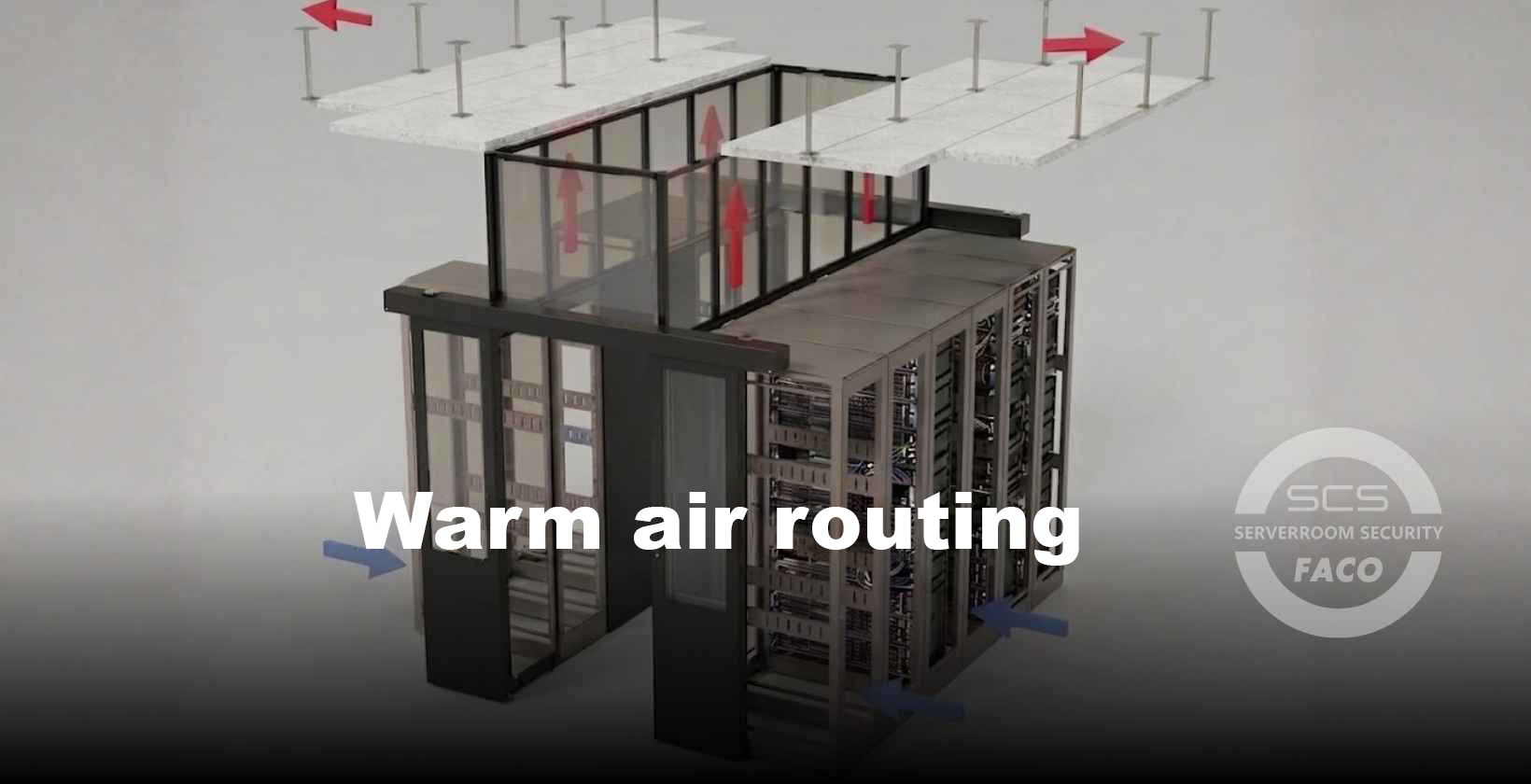
The SCS FACO hot aisle system enables efficient airflow and ensures the safe separation of cold and warm air. The targeted airflow of the HAC chimney design guarantees consistent warm air extraction upwards into the double ceiling. SCS FACO hot aisle enclosures prevent the formation of hotspots and ensure the cooling of sensitive server modules. The SCS FACO chimney elements, available at serverroom-security.com, are compatible with all rack systems and are also available as freestanding aisle solutions for customized applications and easy replacement of server racks. The walls of the SCS FACO hot aisle system are made of steel, Makrolon, or Exolon. HAC door systems keep the warm air inside the enclosure. The metal doors with safety glass or plastic panels are available as self-closing or manually closing versions with free-swinging or synchronized operation.
More
Warm air routing from SCS FACO
Warm air routing is an essential component of data center air conditioning with hot aisle and cold aisle systems. It ensures that the heat generated by servers and other IT components is dissipated in a controlled manner from the immediate rack area.
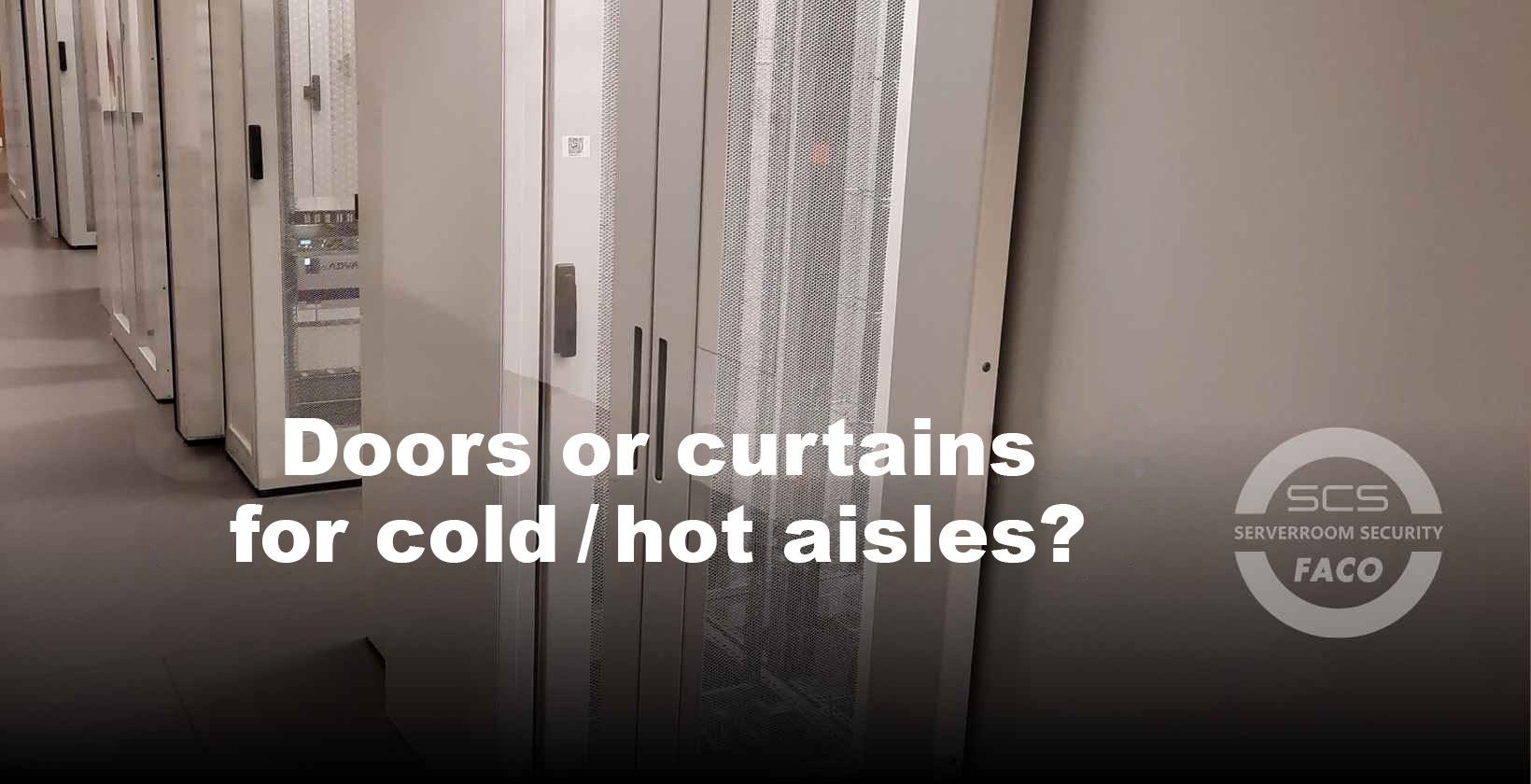
Doors or curtains for cold / hot aisles?
Whether doors or a curtain are more suitable for the cold aisle / hot aisle depends on the individual room conditions and framework within the server room.
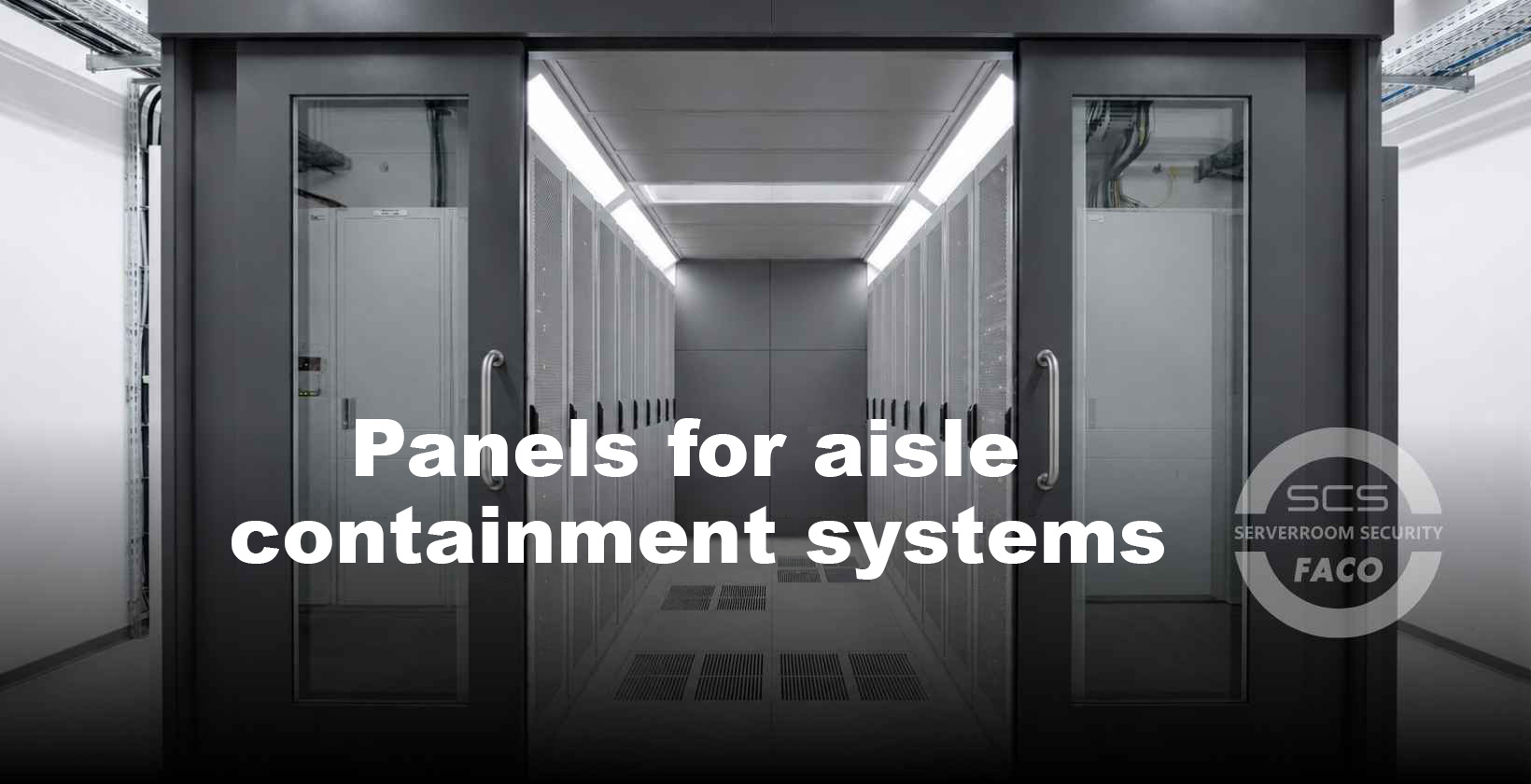
Panels for aisle containment systems from SCS FACO
SCS FACO's aisle containment panels are modular in design and can be individually adapted to existing or planned rack systems.