
 14Feb
Free cooling: definition & functionality
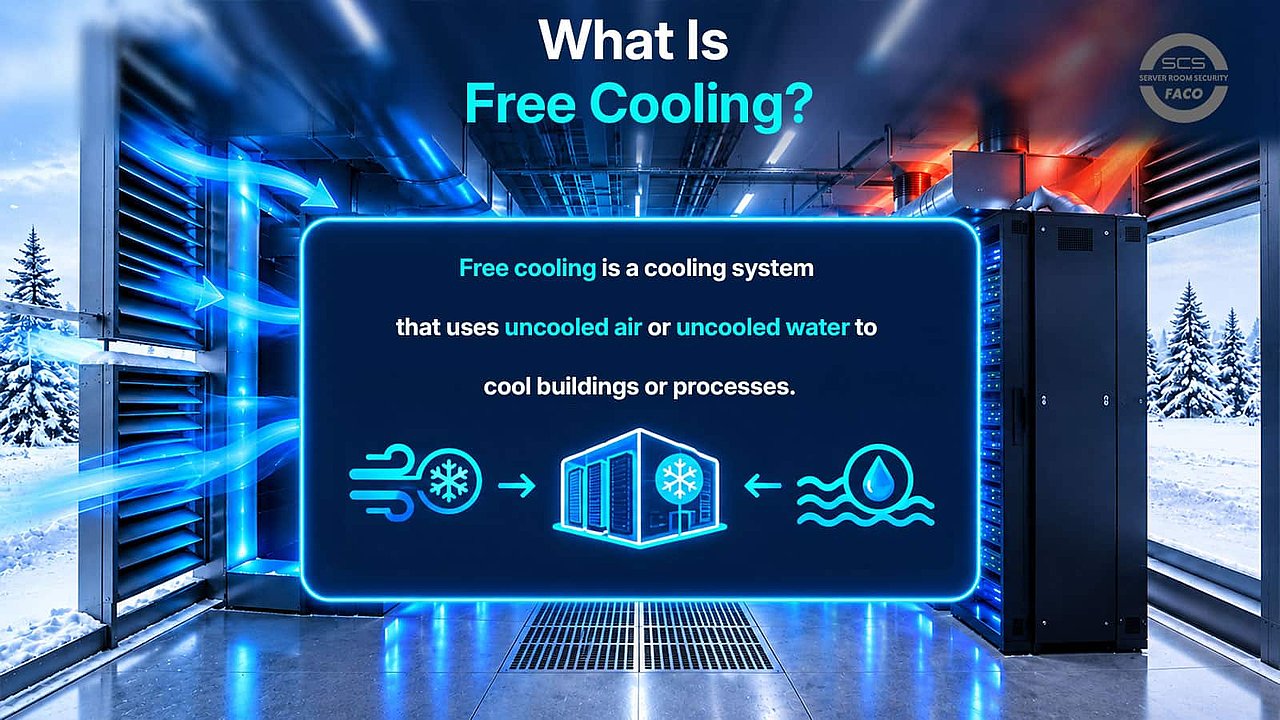
Free cooling utilizes natural ambient temperatures to achieve air cooling without additional energy input. Outside air or cold water is used to dissipate heat and create a cooling effect. The heat exchange process occurs through contact between the warm air and the cooling environment.
According to the trade journal "IKZ Fachplaner," free cooling can achieve energy savings of up to 80%. In free cooling, heat is dissipated through contact with cold outside air or cold water. The cooling system utilizes natural cold sources instead of electrical cooling methods. The temperature difference between indoor and outdoor air is used to cool the rooms.
The principle of free cooling for servers is easy to understand: Cold outside air is supplied to the server, absorbs its heat, and is then released back into the environment. Free cooling requires minimal technical effort. Apart from the power consumption of the fans, no additional energy is needed. Furthermore, air as a coolant is available in unlimited quantities and free of charge.
Cold and hot aisle containment systems with components from SCS FACO represent an innovative extension of free cooling for use in data centers and server rooms. Unlike free cooling, cold and hot aisle systems from SCS FACO, available at serverroom-security.com, reliably prevent temperature fluctuations and provide targeted airflow within server rooms. The cold aisle containment directs cold air precisely to the servers, preventing hotspots through uniform air distribution. The hot aisle containment directs the warm exhaust air from the servers into the suspended ceiling, thus preventing the mixing of the air heated by the servers with the cooler ambient air.
This article provides a detailed explanation of the principle of free cooling. Furthermore, it explains the functionality, advantages, and disadvantages of free cooling in detail and presents alternatives to free cooling for servers.
What is free cooling?
Free cooling is a cooling system that uses uncooled air or water to cool buildings or processes, instead of relying on mechanical cooling devices such as air conditioners or chillers. Free cooling is an efficient way to save energy.
Free cooling utilizes natural ambient temperatures to cool the air heated by IT equipment without requiring additional energy. Unlike electric cooling systems, free cooling, under suitable ambient conditions, represents a cost-effective and energy-efficient alternative. According to the trade journal "IKZ Fachplaner," energy savings with free cooling can reach up to 80%. Free cooling systems offer significant energy savings because utilizing natural ambient temperatures reduces operating costs and minimizes environmental impact.
Free cooling technology is used in various sectors. In the food industry, free cooling is a popular method for ensuring optimal storage temperatures. This reduces energy costs and preserves the freshness and quality of the food. The automotive industry also uses the principle of free cooling to regulate the temperature of vehicle engines.
According to the trade journal “IKZ Haustechnik,” even ancient people utilized the cooling effect of air near water. Porous clay vessels filled with water served for cooling. The effect of evaporative cooling was enhanced by fanning a large fan over the clay pot. Prehistoric hunter-gatherers already knew the advantages of lowering the temperature to make life easier. Preserving perishable foods was achieved not only through drying and salting, but also by storing reserves in cool caves or earthen pits. Free cooling works according to a simple physical principle.
How does free cooling work?
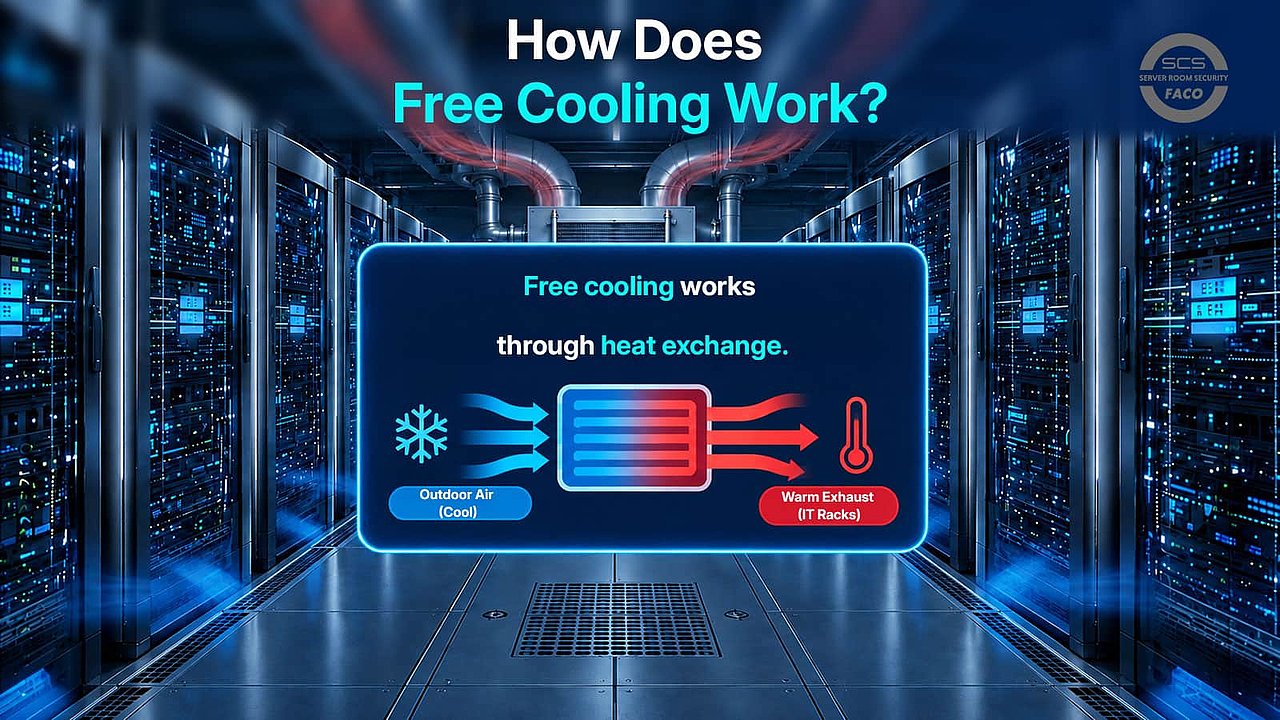
Free cooling works through heat exchange. Cold air or cold water is used to dissipate heat and create a cooling effect. The heat exchange process occurs through the contact of warm air with the cooler environment. Apart from the electricity used to power fans, no energy is consumed.
Free cooling is divided into direct and indirect free cooling. Direct free cooling uses only natural cold sources such as outside air or groundwater to cool data centers and servers. Air filters are required for direct free cooling to regulate air quality, humidity, and temperature to the desired limits. At temperatures below 18°C, cold air is introduced into the building through open windows or a ventilation system. However, at temperatures above 20°C, free cooling increasingly struggles to dissipate heat completely. This is the conclusion of a study by the Swiss Federal Office of Energy and the Zurich University of Applied Sciences.
In indirect free cooling, the data center's indoor air is cooled by a refrigerant that is cooled by the outside air. Free cooling with chilled water systems utilizes either cooling towers or free cooling coils in chillers. This dual cooling transfer results in higher energy consumption. At low heat loads, cooling is provided directly by cooling towers. In this case, the chiller remains off-peak or, if multiple cooling towers are used, operates in parallel with direct free cooling.
Direct free cooling can be used up to an outside temperature of 22 degrees Celsius. If the outside air temperature rises above approximately 22°C, additional cooling measures are required to limit the temperature in the server room to a maximum of 27°C. According to a study by the Swiss Federal Office of Energy and the Zurich University of Applied Sciences, indirect free cooling uses recoolers and heat exchangers with a temperature difference of 3 to 4 K. At outside temperatures of 14°C, the room temperature in a data center is approximately 20°C.
Free cooling with air is the most energy-efficient method, while free cooling with water incurs the lowest costs. This is the conclusion of a case study on data center cooling published in the journal "KI - Kälte Luft Klimatechnik" (AI - Refrigeration, Air Conditioning). The exact costs for free cooling must be calculated on a case-by-case basis.
How is free cooling calculated?
Free cooling is calculated by balancing the average annual generation capacity (Q KK,el,m), the recooling capacity (Q KR,el,m) and the distribution capacity (Q KV,el,m).
The calculation formula for the use of renewable energies in the field of cooling consists of the following components:
The calculation of partial performance indicators for free cooling technologies is based on a systematic approach that considers various energy components of the cooling process. Each partial performance indicator is derived according to an algorithm based on DIN V 18599-7. This standard defines the rules for calculating energy performance indicators for cooling technologies. The partial performance indicator takes into account the generator efficiency, including partial load operation, the auxiliary energy for recooling, and the auxiliary energy for distribution. The partial performance indicator corresponds to a system annual performance factor, considering all significant system losses.
Within the framework of a research project funded by the Federal Institute for Research on Building, Urban Affairs and Spatial Development, the Institute for Air and Refrigeration Technology Dresden, the engineering firm schiller engineering and the German Association for Building Climate have developed new calculation methods for free cooling. The aim of the research project is to develop simplified evaluation methods for the use of renewable energies in the field of cooling.
Free cooling offers some advantages, but also has certain disadvantages.
Advantages and disadvantages of free cooling
Free cooling offers several advantages, including energy savings, cost reduction, and sustainable energy consumption. Its disadvantages include limited application areas, extensive additional measures, and dependence on external conditions.
The advantages and disadvantages are explained in more detail below.
What are the advantages of free cooling?
The advantages of free cooling are low energy consumption and improved efficiency of the cooling process through the use of ambient temperature.
Free cooling chillers are more energy-efficient than conventional chillers. Free cooling contributes to sustainability and cost savings.
The most important advantages of free cooling are summarized in the following list.
- Efficient energy saving: Free cooling uses the natural ambient temperature for cooling. This significantly reduces energy consumption. Particularly in cold or temperate climates, considerable energy savings can be achieved by utilizing outside temperatures.
- Sustainable energy consumption: Low energy consumption and the use of natural resources make free cooling more environmentally friendly than conventional cooling systems. Unlike conventional cooling systems, which often rely on energy-intensive compressors, free cooling operates using the ambient temperature.
- Significant cost reduction: Operating costs can be significantly reduced because no additional energy is required for cooling. Free cooling leads to substantial cost savings because it primarily relies on natural resources such as outside air or water, instead of using energy-intensive cooling systems.
In addition to the advantages of free cooling, there are also some disadvantages to this type of cooling to consider.
What are the disadvantages of free cooling?
The main disadvantages of free cooling are its dependence on environmental conditions, its limitation to specific applications, and the extensive additional measures required. Regions with high ambient temperatures and rooms requiring a constant cooling temperature are not suitable for free cooling.
- External dependency: The efficiency of free cooling depends on the ambient conditions. In areas with consistently high outside temperatures or high humidity, free cooling is less efficient.
- Limited applications: Free cooling is unsuitable for rooms where maintaining a constant cooling temperature is required. Free cooling uses the outside temperature for cooling and is therefore dependent on climatic conditions.
- Extensive additional measures: Free cooling requires filter systems to purify the air. Furthermore, measures are necessary beforehand to compensate for weather-related temperature fluctuations. If the outside air is too cold, warm exhaust air from the cooling system must be introduced via a mixing valve. If the outside temperature is too warm, a refrigeration compressor is activated to regulate the temperature.
What does free cooling cost?
According to a study published in the journal "KI - Kälte Luft Klimatechnik," free cooling with water costs approximately €70,000 per year. The data center studied has an IT capacity of 400 kW and an air-cooled server room. Water cooling is approximately €11,000 cheaper than free air cooling.
The costs for the recirculating air system are independent of the chosen free cooling variant. The data center analyzed in the study published in the journal "KI - Kälte Luft Klimatechnik" has a nominal IT power output of 400 kW and is equipped with an air-cooled server room. The maximum permissible air inlet temperature is 22 °C with a temperature difference of 10 K between the air inlet and outlet temperatures.
While free air cooling requires a complete reinstallation of the outside air system components, free water cooling involves lower investment costs. The chilled water system required for hot summer days only needs minor modifications.
Free cooling is an efficient method for cooling servers and offers many advantages over other cooling systems. However, depending on the application and climatic conditions, other cooling methods may be more efficient.
Alternatives to free cooling: Cold aisle and hot aisle systems with components from SCS FACO
Cold aisle and hot aisle systems with components from SCS FACO offer a safe and innovative alternative to free cooling. The efficient separation of cold and hot air and constant temperature control ensure stable and reliable cooling of server rooms compared to free cooling.
SCS FACO's hot and cold aisle containment systems offer a secure alternative to free cooling for server rooms. The SCS FACO cold aisle containment system, available at serverroom-security.com, directs cold air precisely to the racks, thereby increasing energy efficiency. The modular design of these systems allows for easy customization to meet specific customer needs.
SCS FACO's cold aisle containment (CAC) prevents hotspots and warm air recirculation to the servers. The CAC roof system comprises transparent and durable roof panels made of Makrolon or Exolon, with a height of 150 mm. The roof allows for seamless integration with existing fire protection systems. SCS FACO's CAC door systems, available at serverroom-security.com, seal the cold aisle containment, ensuring efficient flow of cold air to the servers. The doors of the CAC door systems are available in self-closing, manually closing, free-swinging, or synchronized versions.
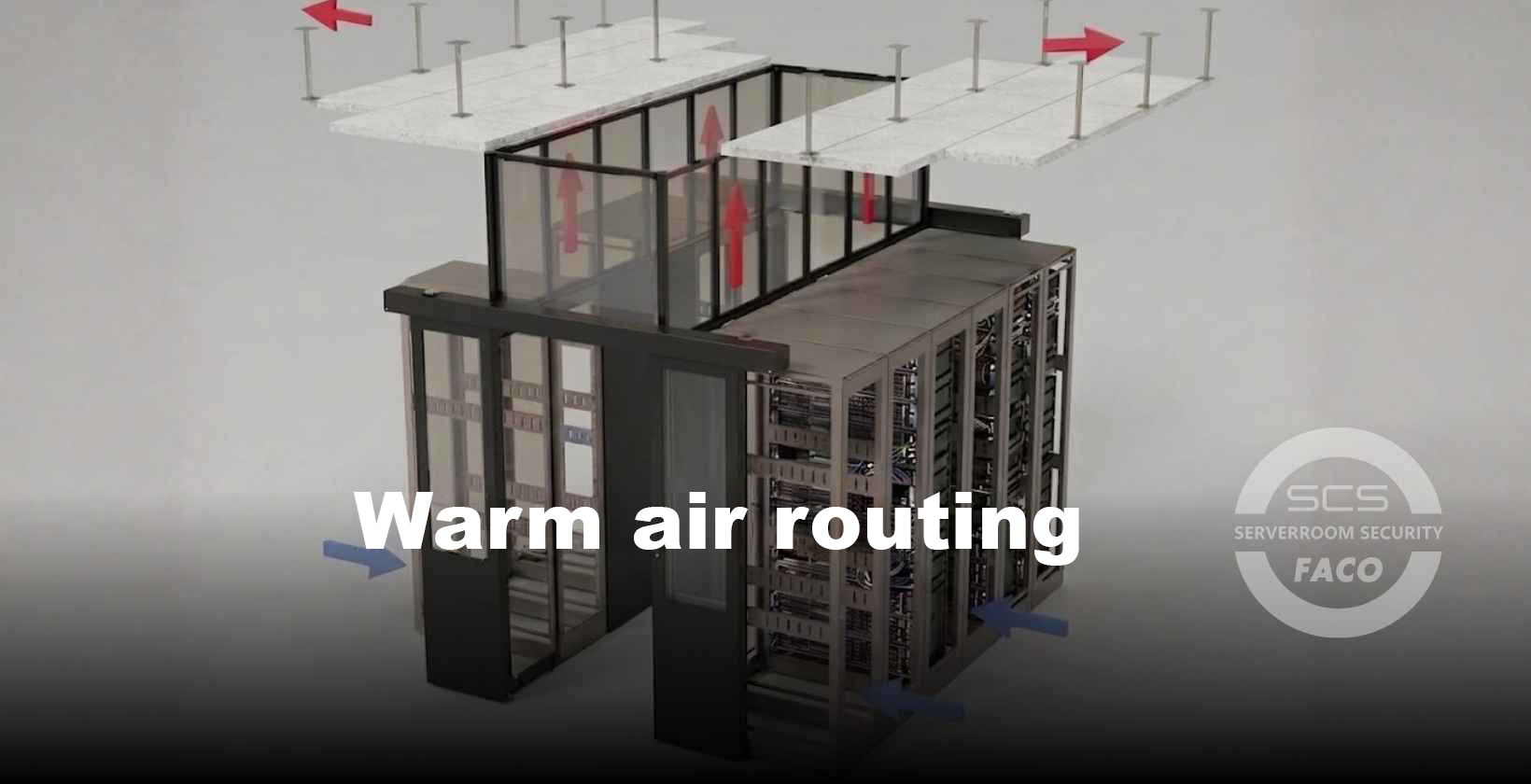
The SCS FACO hot aisle containment system enables efficient separation of hot and cold air. The containment system directs the warm exhaust air from the servers through the chimney into the suspended ceiling. This prevents the mixing of airflows and the formation of hot spots. The modular design of the hot aisle systems allows for adaptation to various server rooms. The HAC chimney construction is made of steel, Makrolon, or Exolon. SCS FACO chimney elements are individually configurable and adaptable to existing rack systems. They are also available as a freestanding aisle solution for individual use and easy replacement of server racks. SCS FACO HAC chimney elements ensure targeted airflow and consistent extraction of warm air into the suspended ceiling. The walls of the SCS FACO hot aisle system are made of steel, Makrolon, or Exolon. HAC door systems close off the hot aisle system, allowing the warm air to be efficiently vented upwards. The sliding doors, with infill panels of safety glass or plastic, are available in self-closing or manually closing versions with free-swinging or synchronized operation.
More
Warm air routing from SCS FACO
Warm air routing is an essential component of data center air conditioning with hot aisle and cold aisle systems. It ensures that the heat generated by servers and other IT components is dissipated in a controlled manner from the immediate rack area.
Doors or curtains for cold / hot aisles?
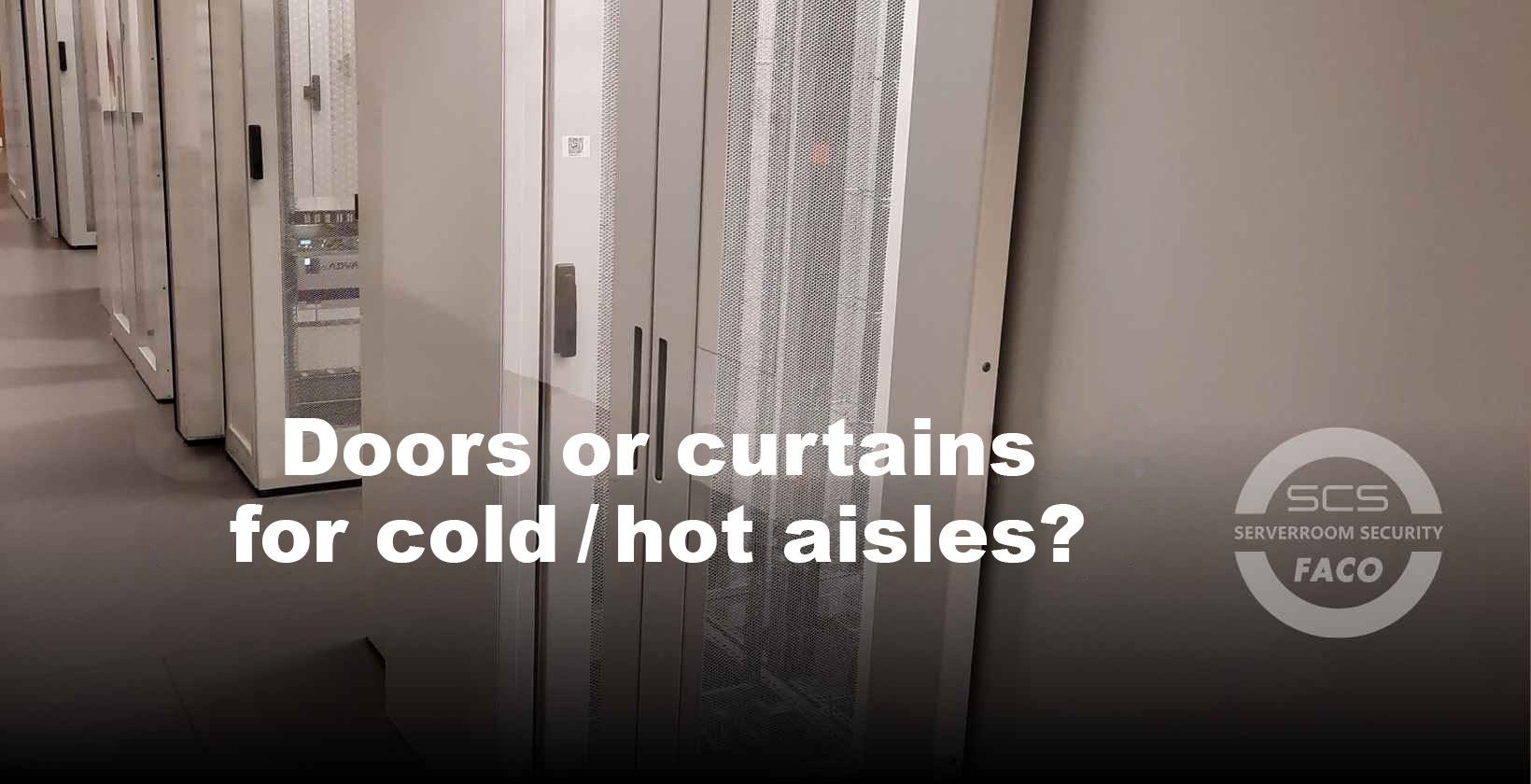
Whether doors or a curtain are more suitable for the cold aisle / hot aisle depends on the individual room conditions and framework within the server room.
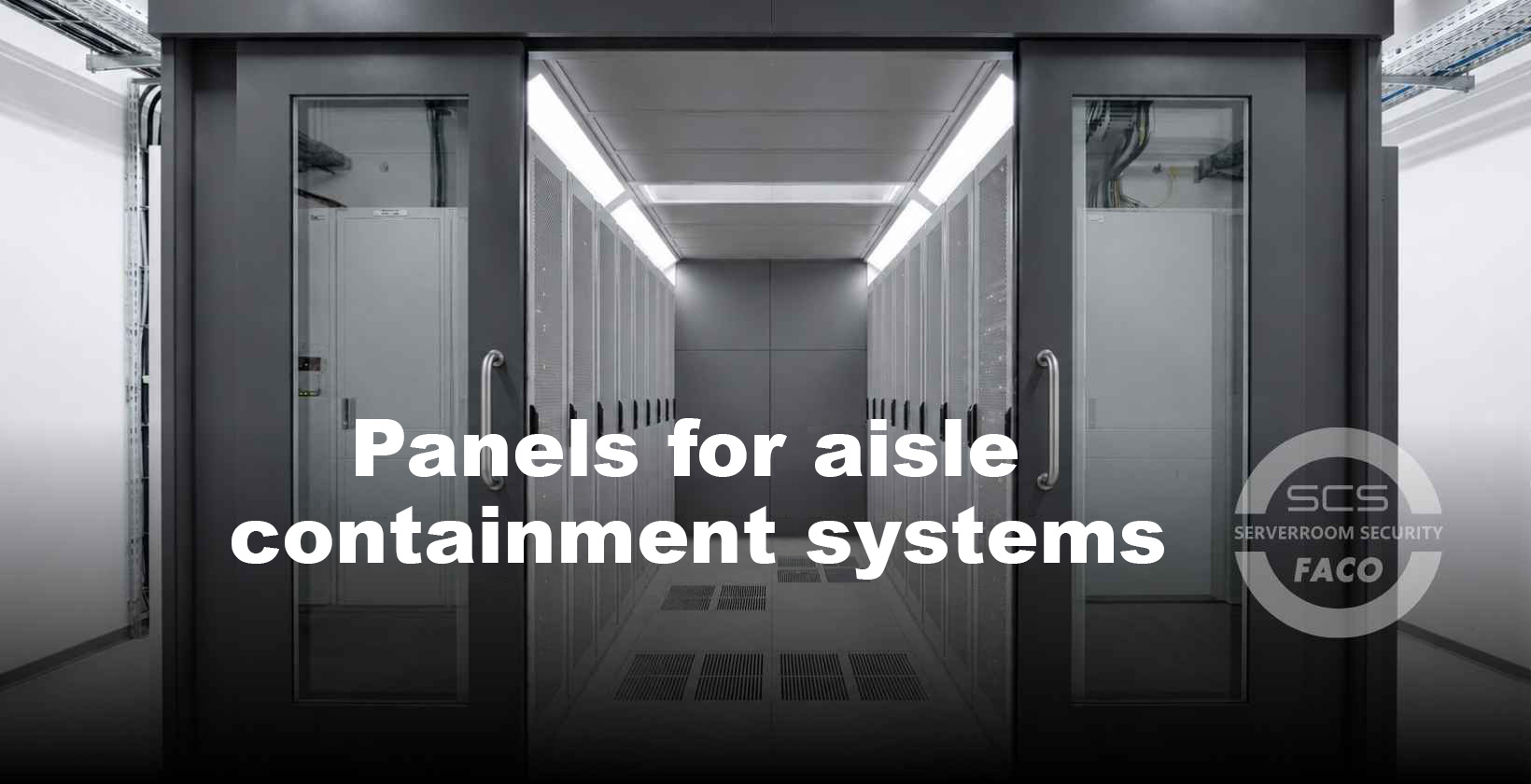
Panels for aisle containment systems from SCS FACO
SCS FACO's aisle containment panels are modular in design and can be individually adapted to existing or planned rack systems.