
 11Jul
11JulCooling air duct from SCS FACO
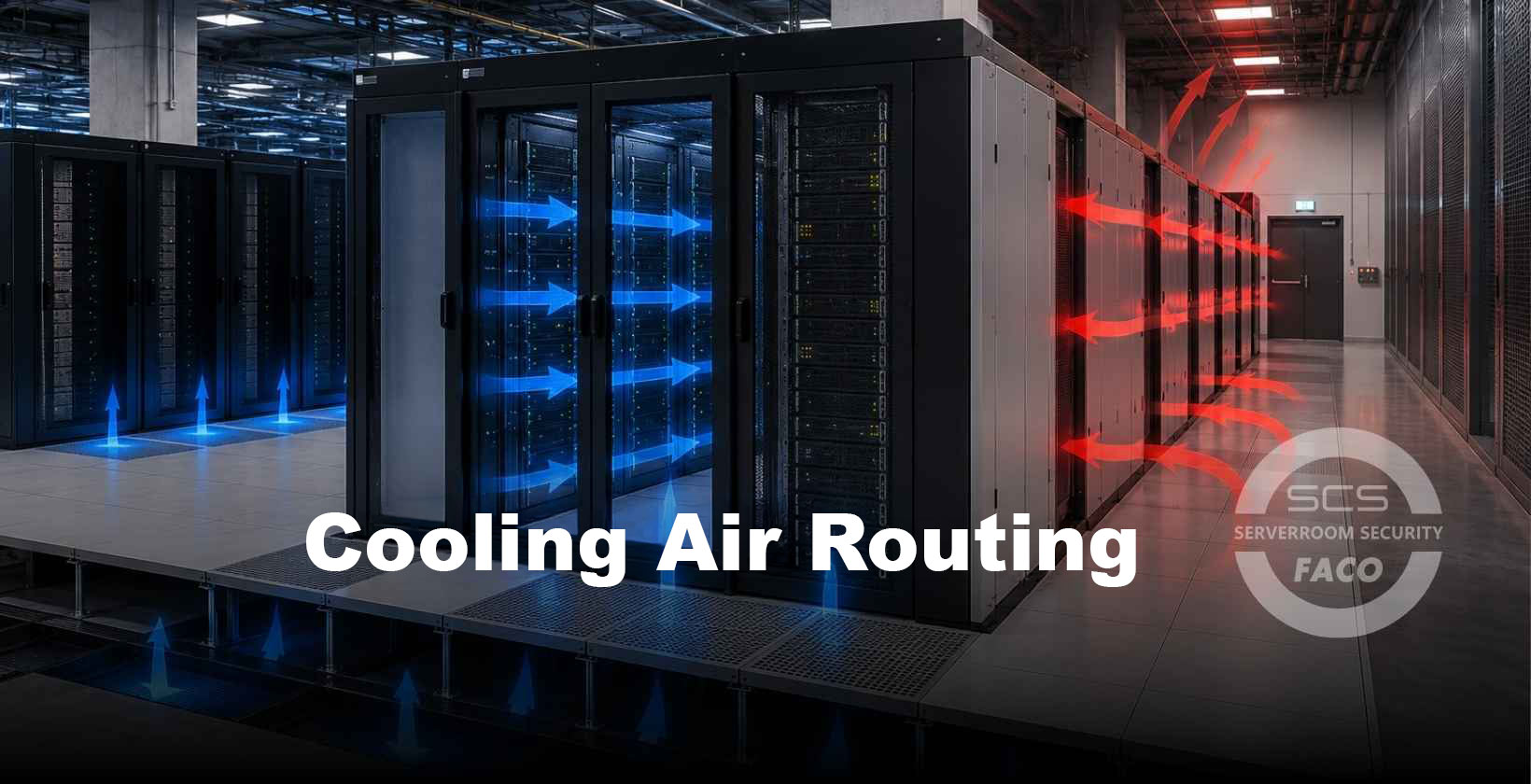
Cooling air distribution in the data center involves directing cool air to the IT equipment and controlling the removal of the resulting warm exhaust air back for cooling. The goal of cooling air distribution is to maintain stable, predictable thermal conditions without uncontrolled air mixing, ensuring the reliable operation of servers, storage, and network components.
A cooling air distribution system consists of cooling units, fans, and air ducts or raised floors. Cooling units such as CRAC/CRAH units handle air conditioning, fans ensure the necessary circulation, and air paths are organized via air ducts, raised floors, or structural guide elements. This principle is particularly effective when combined with the enclosure of cold or hot aisles, as this allows for the consistent separation and routing of airflows.
SCS FACO offers individually configurable cold and hot aisle containment systems that measurably improve cooling air flow through containment and strict separation of cold and hot air.
Why is optimal cooling airflow important?
Optimal airflow is important to ensure the efficiency of cooling and ventilation of servers and other hardware in the data center.
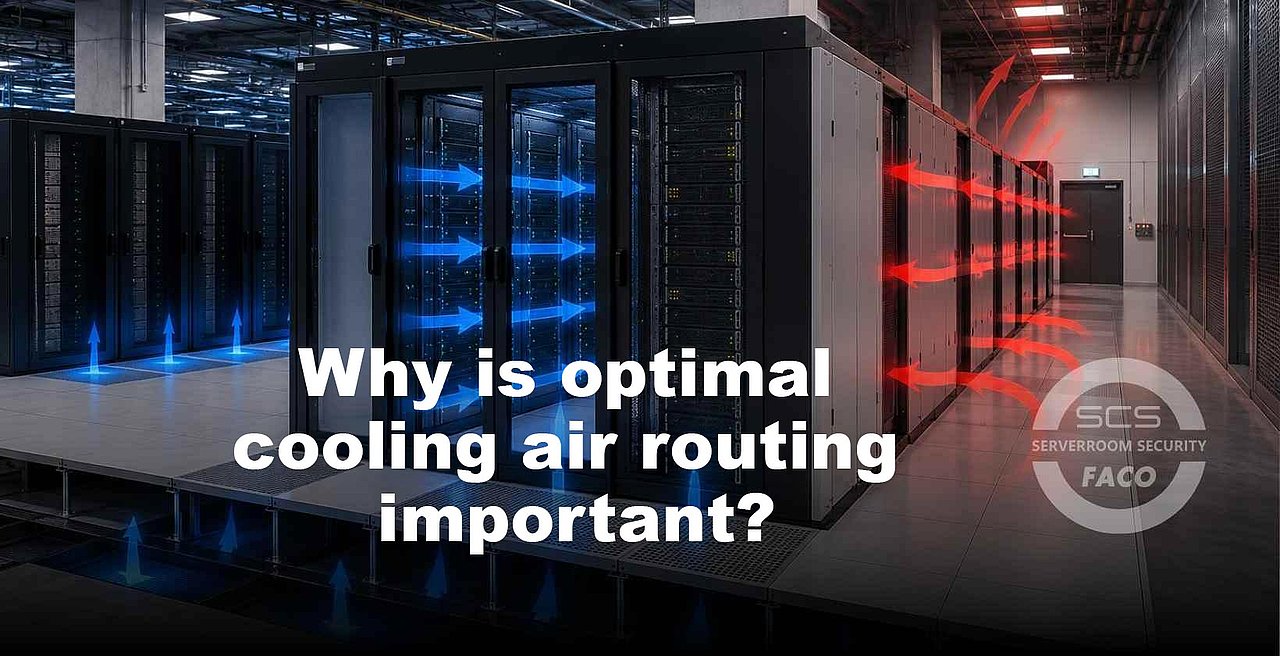
Optimal airflow management ensures the separation of warm and cold air. The goal of this system is to ensure that the cooled air arrives at the server air inlets as supply air, while the warm air flows directly to the cooling system's return lines.
Components for cooling air distribution ensure that the temperature in the data center remains constant and that the air is optimally distributed. These include air conditioning units (CRAC/CRAH) that maintain a constant air temperature in the data center, as well as fans in the air conditioning units and in the servers themselves, which distribute the air and exhaust the warm air. Air ducts or raised floor systems transport the cooled air to the racks, while the warm exhaust air is returned to the cooling system via defined recirculation paths. If a cold aisle containment system is also used, the cooled air remains confined within the cold aisle, which stabilizes the air supply to the server inlets and further improves thermal separation.
The practical benefit of precise cooling air routing lies in the optimized removal of heat loads. In many data centers, without consistent air separation, a significant portion of the generated cold air is lost as so-called bypass air. Bypass air is air that never reaches the server but instead enters the return air system unused. A well-designed cooling air routing system reduces the risk of bypass air by directing the cold air as completely as possible into the cold aisles, while the warm exhaust air is routed to the hot aisles. From there, the warm air is reabsorbed by the cooling systems. The result is improved efficiency and operational reliability.
Optimal airflow is crucial to prevent hotspots. Hotspots often develop due to airflow recirculation. This occurs when warm exhaust air from the rear of the rack re-enters the front through gaps, open rack units, or unsealed areas, and is drawn back in by the servers. This recirculation leads to significantly higher local inlet temperatures, causing individual systems to overheat more quickly, fans to spin up, and IT components to throttle their operation as a protective measure. Clean airflow with clearly separated hot and cold zones minimizes the risk of overheating and contributes to uniform temperature profiles throughout the rack.
Optimal airflow for cooling sustainably reduces energy costs, as cooling accounts for up to 40% of total costs in data centers. In many IT environments, cooling contributes roughly 30 to 40% to total electricity costs. By directing cool air precisely to the servers without losses, it's possible to reduce the required cooling capacity or create headroom for operating at higher, more efficient target values. This has a positive impact on operating costs and simultaneously stabilizes operating conditions.
Stable airflow extends the lifespan of the hardware. Maintaining consistent temperatures through efficient airflow prevents internal server fans from constantly running at maximum speed, thus reducing wear and tear. The potential power density increases because the cooling system operates efficiently. Modern server racks generate enormous amounts of heat in a confined space. With optimized airflow combined with enclosures, it is possible to safely operate power densities in the range of approximately 15 kW to 30 kW per rack, because the supply of warm air and the exhaust of hot air are more easily controlled.
What are the advantages of our cooling air routing?
The advantages of our cooling air routing through enclosures are the high cost savings and improved energy efficiency for maximum power density in the data center.
The central mechanism is the targeted thermal separation between the cooled air supplied by cooling units and the warm server exhaust air. When cold and warm air are not mixed, the overall system operates more predictably: the IT equipment receives the necessary supply air temperature where it is needed, and the return air reaches the cooling system warmer and, most importantly, unmixed – a key efficiency factor in air-based systems.
Our cooling air routing helps reduce operating costs. Depending on the initial situation and the degree of implementation, potential savings of 10-30% in operating costs are possible through containment. The key is not a single component, but the consistency of its execution. Enclosures reduce the mixing of air masses, prevent unnecessary bypass airflow, and minimize recirculation. Bypass air provides no cooling effect for IT equipment, yet it still consumes energy. Consistent cooling air routing with enclosures ensures a tight seal and clear air paths. This includes properly sealed cable penetrations and openings, as well as blanking panels in empty rack areas, so that the air actually flows through the servers.
Our cooling airflow system helps prevent recirculation. Recirculation occurs when warm exhaust air returns to the inlet, mixes with the cooled air, and thus increases the inlet temperature. An enclosure promotes efficient heat dissipation because the warm air remains in the warm zone and is not forced back into the cold zone. This reduces the risk of hotspots and ensures that similar temperatures are achieved in the upper rack units as in the lower areas, resulting in more uniform cooling of all IT components.
Another advantage of our cold air routing is the increase in delta T values. Delta T is a key metric in data centers and describes the temperature difference between cool supply air and warm exhaust air. Typical delta T values range between 10 and 12 °C. In highly efficient IT environments, a delta T of 14 °C is the target. When warm exhaust air reaches the cooling units unmixed, the return temperature rises, and consequently, so does the delta T. A greater temperature difference improves the efficiency of the heat exchanger in the air conditioning unit in many systems. Therefore, achieving the highest possible delta T value is often a requirement in standard data center guidelines, which are based on recognized recommendations such as the ASHRAE Thermal Guidelines.
Our cooling air routing enables maximum utilization of free cooling. Heat exchangers operate more efficiently when the return temperature is high because there is no mixing with cold air. This results in more hours per year in many climate zones where free cooling with outside air can be used. This reduces the need for energy-intensive mechanical refrigeration and improves operational efficiency without compromising IT security.
Cooling air duct from SCS FACO
SCS FACO's cooling air routing is based on efficient cold aisle containments that are individually adapted to the local conditions.
In data centers, rack rows, aisle widths, ceiling heights, and interfaces can vary considerably. Enclosures clearly define the cold zone, keeping the cold supply air where the servers need it, while thermally separating the hot zone and allowing for controlled exhaust of warm air.
Our cooling air duct system offers high mechanical stability. SCS FACO enclosures are constructed of aluminum and steel. These enclosures provide the necessary stability for safe operation, preventing warping of doors, panels, or roof modules, or the unintentional formation of gaps that could impair airflow.
We offer door systems with automatic closing for reliable cooling airflow. Open doors are one of the most common causes of a sudden decrease in cooling airflow, as they immediately eliminate thermal separation and cause cold and warm air to mix again. Automatically closing doors reduce this risk and support stable operation because the cold aisle remains closed even if doors are accidentally left open during normal daily operations. Furthermore, the door technology can be integrated into electronic locking systems, which is particularly relevant in environments with increased access control and operational safety requirements.
Our enclosures are vendor-neutral. SCS FACO enclosures can be adapted to various server rack types, meaning operators and colocation providers are not tied to a specific server rack manufacturer. This ensures the solution remains compatible with existing IT infrastructures and future expansions, which may involve changes to rack models or expansion concepts.
For which data centers is our cooling air duct suitable?
Our cooling air routing is suitable for all data centers that allow the integration of enclosures, such as colocation data centers, existing data centers, high-density data centers and medium-sized server rooms.
Our cooling air distribution system is suitable for colocation data centers. In colocation data centers, the efficient cooling of clearly defined customer areas is often a top priority. Containment helps to better control airflow per unit area and reduce operating costs because less cool air is lost and cooling is targeted. A defined cooling air distribution system supports reliable operating conditions for different customer setups, preventing individual hotspots from destabilizing the data center environment.
Retrofitting existing data centers often presents a particular challenge because room geometries, existing racks, and already installed infrastructure are rarely ideal. The modular design of our enclosures is advantageous here, as solutions can be adapted to individual heights, widths, and conditions. Especially during modernization projects, it is crucial that cooling airflow can be improved without requiring a complete redesign of the data center, and that the measures can be implemented in phases.
Our cooling air distribution system is ideally suited for high-density data centers. In high-density data centers, where blade servers or AI infrastructure generate significant heat in a confined space, clean air separation is particularly critical. If warm air is drawn back in or cold air doesn't reliably reach the inlet, temperatures rise rapidly. Enclosures support the separation of airflows and help prevent overheating because the warm exhaust air remains in the hot zone, while the cold zone is consistently supplied with cooled air. Especially with increasing rack capacities, controlled cooling air distribution in the data center is essential for operational reliability and predictable scalability.
Medium-sized server rooms with approximately 5-10 racks benefit from the scalability of our cold air distribution systems with modular panels and roof elements. In such environments, budgets are often tighter and space is limited. The clear separation of cold and hot zones and the consistent sealing of openings result in more uniform cooling, reduced hotspots, and overall more efficient cold air distribution in the data center.
More

Digital transformation at FACO Metalltechnik
Digitization is having an increasing impact on our management and employees. We are adapting our processes to be customer-oriented.

SCS Secure Cage Systems
Planning, production and assembly of security cages for data centers - made in Germany

Digital transformation at FACO Metalltechnik
Digitization is having an increasing impact on our management and employees. We are adapting our processes to be customer-oriented.