
 07Jun
07JunContainment systems | SCS FACO
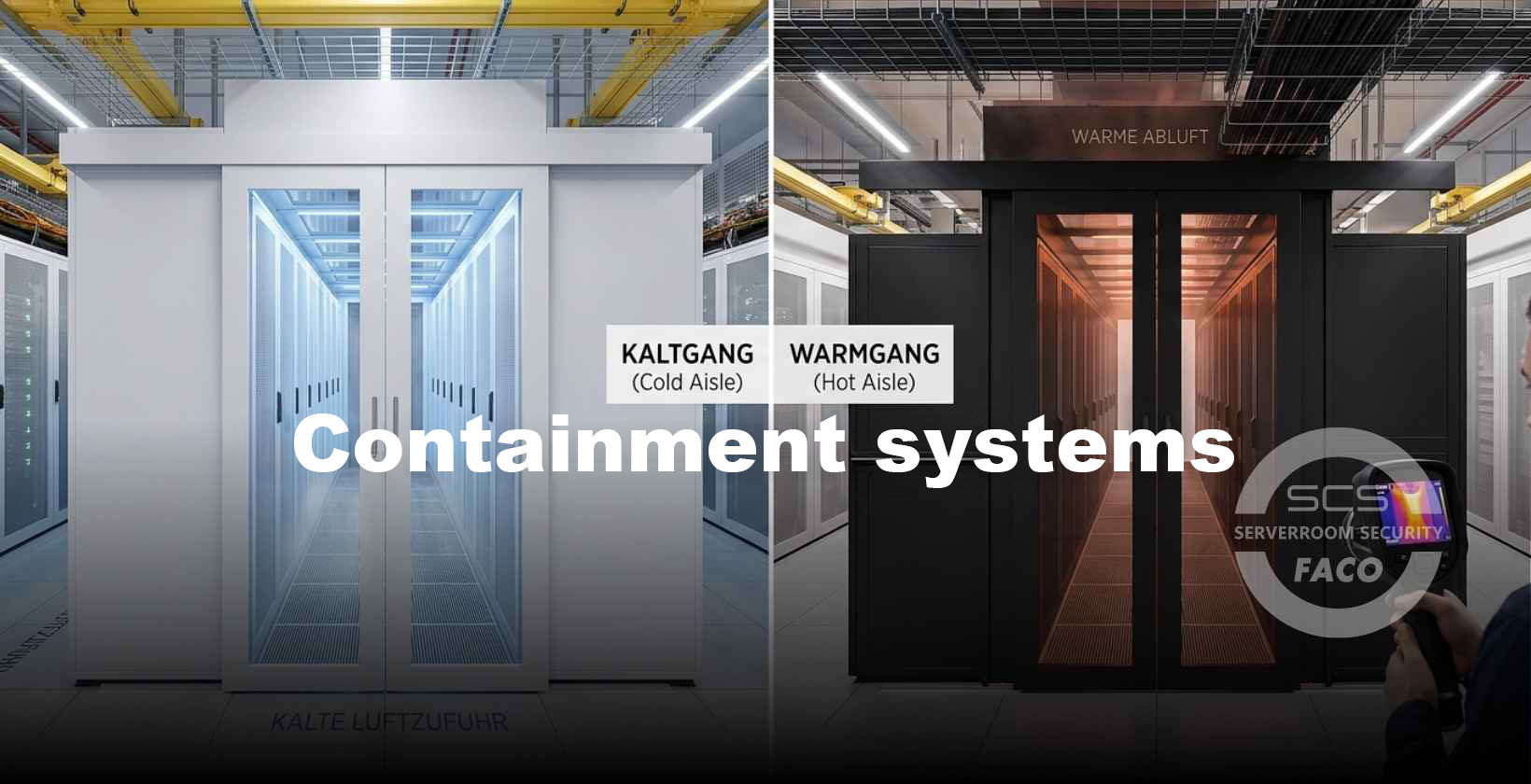
Containment systems are aisle enclosures in data centers that ensure a strict separation of cold and warm air. SCS FACO manufactures high-quality containment systems for all types of data centers.
Containment systems comprise cold aisle containment (CAC) and hot aisle containment (HAC). The goal of containment systems is to ensure controlled airflow. Containments direct cold air to where it's needed at the front of the rack, while hot air is extracted without mixing with the supply air. A containment system is therefore an effective measure to increase cooling efficiency in the data center, protect IT equipment from overheating, and maintain an optimal indoor climate.
SCS FACO containment systems are modular and characterized by high-quality manufacturing and durability. Our containment systems are based on robust materials such as powder-coated steel and heat-resistant Exolon panels. Thanks to their modular design, both cold aisle and hot aisle containment systems can be adapted to different rack configurations, room geometries, and growth scenarios.
Containment systems enhance the effectiveness of existing cooling concepts through improved airflow. Therefore, for operators prioritizing energy efficiency, operational reliability, and predictable scalability, containment systems are among the most important measures in data center operations. Industry guidelines for the planning of containment systems often include recommendations regarding the thermal operating environment of IT equipment (such as ASHRAE guidelines).
On this page we describe our range of containment systems and discuss their special advantages.
Our containment systems
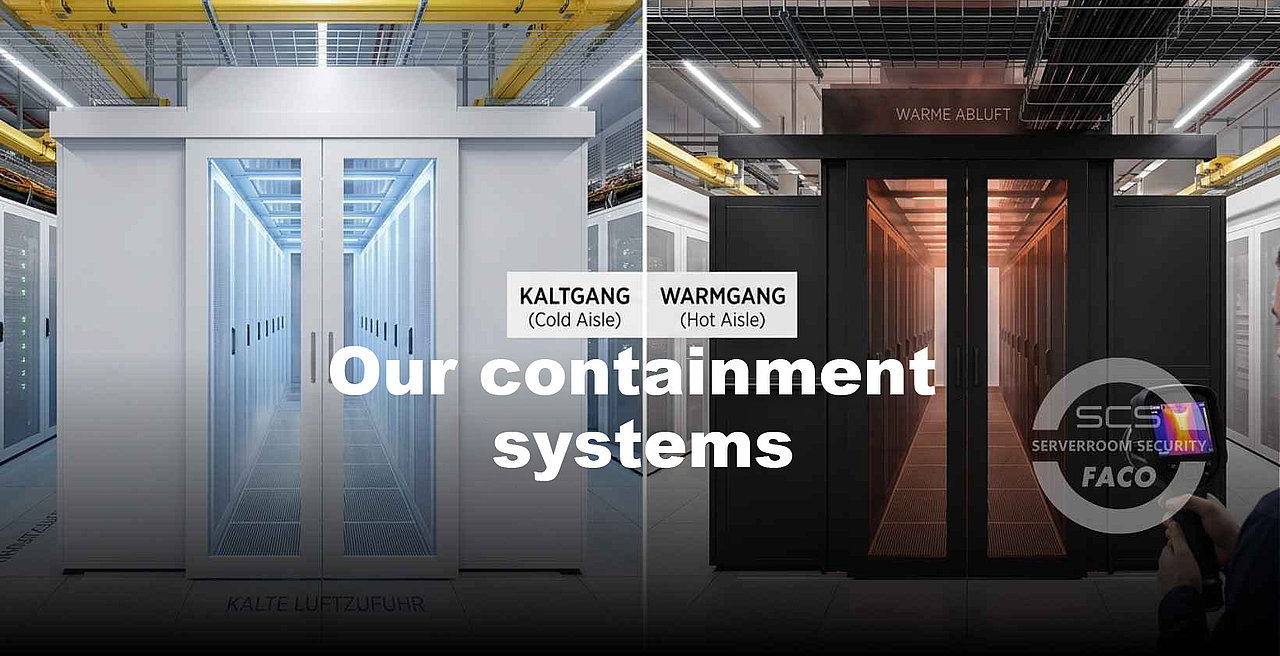
SCS FACO's containment systems are modular cold aisle and hot aisle containments designed for the clear separation of air zones in the data center.
The modular design of our containment systems offers a significant practical advantage during operation. Systems can be configured to fit the required aisle length, width, and existing rack rows, and expanded with additional elements as needed. This ensures the containment remains adaptable even when data center floor space changes or additional racks are integrated.
Our containment systems are characterized by high-quality manufacturing. Production takes place on CNC-controlled machines and is supervised by trained personnel. Our manufacturing focuses on dimensional accuracy, repeatable quality, and clean, seamless transitions, because in aisle containment systems, the attention to detail determines how effectively warm and cold air remain separated.
Our containment systems are made from durable and robust materials. Powder-coated steel ensures stability and resistance. For transparent, load-bearing surfaces within enclosures, we use heat-resistant Exolon panels.
Below we describe our cold aisle and hot aisle containment systems in detail.
Cold aisle containment
Cold aisle containment is a measure used in data centers to optimize cooling by strictly separating warm and cold air zones. The front ends of the racks are positioned opposite each other, and the aisle between them is enclosed. This creates a cold air zone where the servers draw in controlled fresh air without it mixing with the warm exhaust air.
Airflow in cold aisle containment systems is typically facilitated by a raised floor. Cold air is drawn in through the raised floor and distributed by fans, causing the front of the rack to draw in the cold air. The heat generated by the servers is then dissipated through the rear of the rack into the unenclosed area.
Strict separation between cold and warm air is crucial for efficient data center operation. The enclosed cold aisle remains thermally clean because the warm exhaust air stays outside the cold aisle. This reduces the likelihood of warm air re-entering the equipment fronts and causing elevated intake temperatures. The key advantage of our cold aisle containment systems for operators is the more stable temperature conditions, which increases operational reliability and improves overall cooling efficiency.
Hot Aisle Containment
Hot aisle containment is an effective method for separating hot and cold air in data centers by constructively enclosing the hot aisle.
Our hot aisle containment systems consist of a structure made up of doors, panels, and chimney elements. While cold aisle containment (CAC) systems enclose the supply air zone, hot aisle containment (HAC) systems focus on the controlled capture and removal of hot exhaust air.
In hot aisle containment systems, the server racks are positioned so that their backs face each other. The exhaust air from the servers is contained within the hot aisle between the rows of racks, allowing the heat to collect and be dissipated in this specific area. The rest of the server room is supplied with cold air. This principle promotes clear thermal zoning. Cold air remains available in the designated supply air zone within the server room, while the warm exhaust air stays within the enclosed hot aisle and does not flow uncontrollably back into other areas. Especially in high-density data center environments, the strict separation of cold and hot air is crucial for preventing hotspots and ensuring transparent airflow patterns within the data center.
What are the advantages of containment systems?
Containment systems offer the advantages of an effective protection system against overheating of IT components through a strict separation between cold and warm air.
Containment systems ensure targeted airflow. Cooling operates more predictably and efficiently when cold supply air does not mix with warm exhaust air. This reduces the risk of servers drawing in warm air. If servers draw in warm air, this typically leads to higher component temperatures, potential throttling effects, and, in extreme cases, IT equipment failures. Containment systems help protect IT equipment from overheating by directing cool air to where it is needed and keeping warm exhaust air out of the supply air zone.
A practical advantage of containment systems is that they allow for a large temperature difference between warm and cold air. This large temperature difference helps cooling units operate more efficiently because the airflows are less prone to short-circuiting, and the desired temperature differential is achieved more consistently. In many data centers, consistent air separation through containment allows the supply temperature of the air conditioning system to be raised to 22 to 24 °C. Often, a supply air temperature of 22 to 24 °C is sufficient thanks to the targeted airflow provided by containment systems, because the warm and cold air do not mix.
Containment systems help maintain stable humidity levels in the data center. A persistently dry data center environment with less than 40% relative humidity increases the risk of electrostatic discharge (ESD). ESD events are caused by uncontrolled discharges and, if microchips are damaged, lead to malfunctions and failures.
Containment systems from SCS FACO
SCS FACO containment systems are characterized by their modular design and flexibility.
Our containment systems can be functionally and structurally customized to suit any data center environment. The modular design of our containment systems is such that they can be adapted to any size requirement and easily expanded with additional panels. The modularity of our enclosures is particularly relevant for data centers that grow incrementally or whose rack rows are rearranged over time. A modular aisle containment system grows with the needs of the data center without requiring a complete redesign.
Our containment systems can be customized with individual panels and door systems. This allows for easy adaptation of design and function to operational requirements. Our door systems are designed for electronic and mechanical locking systems, supporting both organizational access requirements and data center security concepts.
SCS FACO containment systems are designed for the durable and precise separation of cold and warm air. We achieve the high durability and precision of our aisle containments through the selection of robust materials, high-quality manufacturing using CNC machines, and installation by trained personnel.
More

Digital transformation at FACO Metalltechnik
Digitization is having an increasing impact on our management and employees. We are adapting our processes to be customer-oriented.

SCS Secure Cage Systems
Planning, production and assembly of security cages for data centers - made in Germany

Digital transformation at FACO Metalltechnik
Digitization is having an increasing impact on our management and employees. We are adapting our processes to be customer-oriented.