
 24Jun
24JunAisle closure for cold/hot aisle | SCS FACO
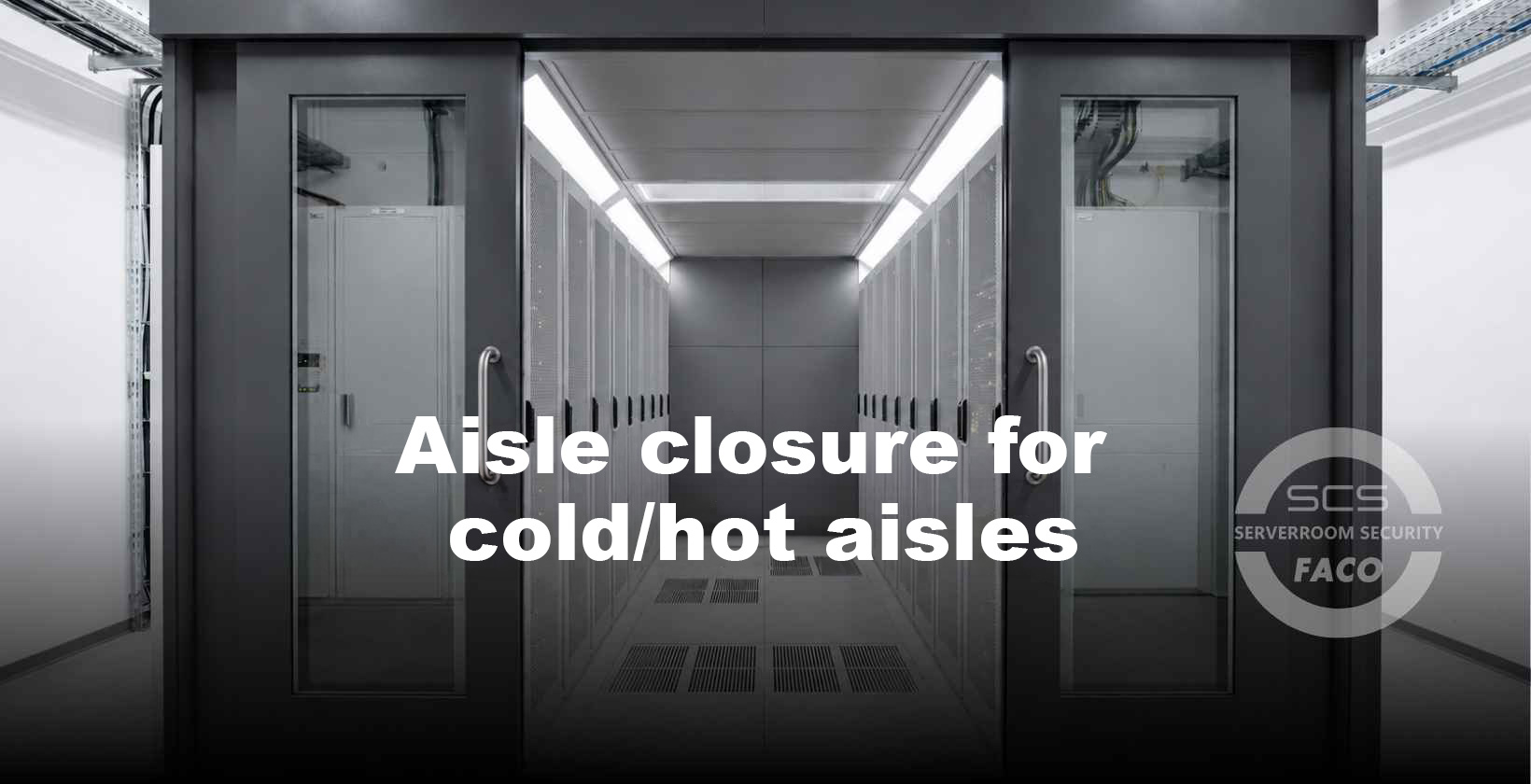
A cold/hot aisle closure is a structural element that specifically isolates cold and hot aisles at their ends.
In data centers and server rooms, this clean separation is crucial for controlled airflow. Controlled airflow prevents unwanted mixing of supply and exhaust air, thus improving cooling efficiency. Open or leaky end walls at the aisle ends of cold or hot aisle containment systems promote airflow short circuits, unstable temperatures, and unnecessary energy losses.
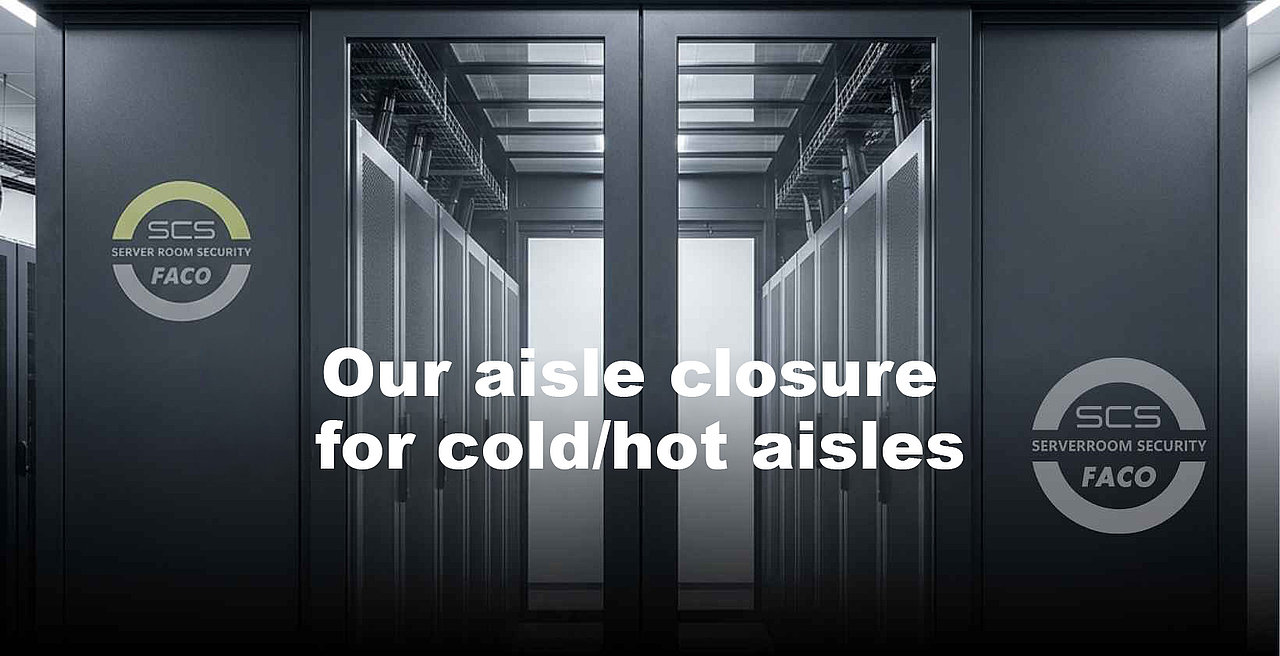
Our aisle closures for cold/hot aisles consist of fixed panels and/or door systems. Depending on the available space and access requirements, sliding or hinged doors are used. The doors are designed to reliably close the aisle at the end, thus ensuring a defined airflow direction in the cold or hot aisle.
The advantages of our aisle closures for the cold/hot aisle lie primarily in stable temperatures in the cold and hot aisle, a noticeable reduction in energy costs, the prevention of bypass air currents, and the creation of necessary air pressure.
Doors and panel enclosures complement each other functionally in the construction. Panels provide excellent sealing at the corridor end and support optimized airflow. Doors additionally create convenient access without compromising the functionality of the enclosure, provided they are precisely fitted and cleanly integrated into the building structure.
Our aisle closure for cold/hot aisles
Our aisle closure for cold/hot aisles is suitable for various aisle widths and aisle heights.
Our aisle closures are individually tailored to the specific room and system conditions. Rack rows, ceiling heights, existing floor space, and escape routes create varying parameters. An aisle closure must be designed to adapt to the respective server room requirements and reliably seal off the cold or hot aisle.
Powder-coated steel sheet panels are used as corridor closures. These panels are made of sheet steel without perforations and are available in either powder-coated or galvanized finishes. The steel sheet provides a robust and permanently stable construction, ensuring smooth operation and allowing for repeated access without any problems.
SCS FACO supplies high-quality door systems consisting primarily of sliding and hinged doors. Sliding doors are available in inward or outward-running versions and can be configured to accommodate both electronic and manual locking systems. This flexibility is particularly important when maintaining airflow is crucial while also ensuring defined access or operational procedures within the corridor. Hinged doors are also available, in both left- and right-hand versions. These options are compatible with both electronic and manual locking systems. This allows for corridor end design that optimally balances access, usability, and security.
What advantages do our aisle closures offer for cold/hot aisles?
Our aisle closures for the cold/hot aisle have the advantage of ensuring stable temperatures in the cold and hot aisle and reducing energy costs.
Our cold/hot aisle seals contribute to reduced energy costs. This reduction is achieved by making cooling more efficient by preventing the mixing of cold and warm air. The seals provide a tight seal, preventing the recirculation of hot exhaust air. The generated cold air is then available where it's needed, instead of being lost through leaks. In environments with long operating hours and high loads, this improved airflow significantly impacts energy consumption.
Stable temperatures are achieved because servers are supplied with a more even flow of cooled air. If the airflow at the aisle end is not interrupted, the temperature profile in the cold aisle remains more stable, reducing the risk of localized overheating. This also reduces the formation of hotspots, which often occur where airflow unexpectedly breaks down or warm air mixes back in. A properly sealed aisle end therefore supports thermal operational reliability because it makes the intended airflow paths more likely.
Another key advantage of our aisle closures is the prevention of bypass airflow. Without an aisle closure, cold or warm air escapes at the sides. This increases the risk of a thermal short circuit, where warm exhaust air flows back into the cold aisle without a closure. These bypass flows are particularly critical because they negate the separation between supply and exhaust air, thus partially negating the purpose of the enclosure. A suitable aisle closure at the end of the aisle counteracts this effect by closing the air path and keeping the air within the defined duct.
Another advantage of our aisle seals is the ability to build up air pressure. A slight positive pressure typically exists in the cold aisle because cold air is forced into it by the fans in the raised floor. Aisle seals close off the cold or hot aisle, allowing this slight pressure to build up and be maintained more effectively without mixing the cold and warm air. This aspect is often crucial because an enclosure promotes more stable airflow. The less leakage at the aisle end, the more consistently the desired pressure conditions can be maintained.
Aisle closures vs. doors for cold/hot aisles from SCS FACO
SCS FACO's cold/hot aisle partitions and doors are individually tailored to server room requirements. The choice between fixed aisle partitions (panels) and doors depends on accessibility, space requirements, operational processes, and specifications arising from the building design.
Cold/hot aisle enclosures are often designed as fixed blind panels when the aisle enclosure is only accessible from one side. Precisely fitting sheet steel panels ensure a perfect seal without pressure loss and provide stability at the same time.
Fire protection and escape route regulations must be taken into account during the planning phase. For example, a second escape route may be required according to ASR A2.3, which influences the choice of door systems and their design at the end of the corridor.
Doors are used to close off corridors when regular access through the end of the corridor is required or when operational processes necessitate it. Sliding doors are often the preferred solution because they save space and do not protrude into the room. Alternatively, hinged doors are used in single or double-leaf versions, particularly when the structural conditions or the desired passage width suggest this.
For day-to-day operations, automatic closing systems are usually the best option, either motorized or using a slight incline in the tracks. This ensures the door returns to the closed position after passage, preserving the benefits of the aisle closure at the end of the corridor. Security and access control can also be incorporated, for example, via RFID card readers or biometric sensors, if access to the cold or hot aisle needs to be regulated accordingly.
More

Digital transformation at FACO Metalltechnik
Digitization is having an increasing impact on our management and employees. We are adapting our processes to be customer-oriented.

SCS Secure Cage Systems
Planning, production and assembly of security cages for data centers - made in Germany

Digital transformation at FACO Metalltechnik
Digitization is having an increasing impact on our management and employees. We are adapting our processes to be customer-oriented.