
 20Feb
Adiabatic cooling: definition & functionality
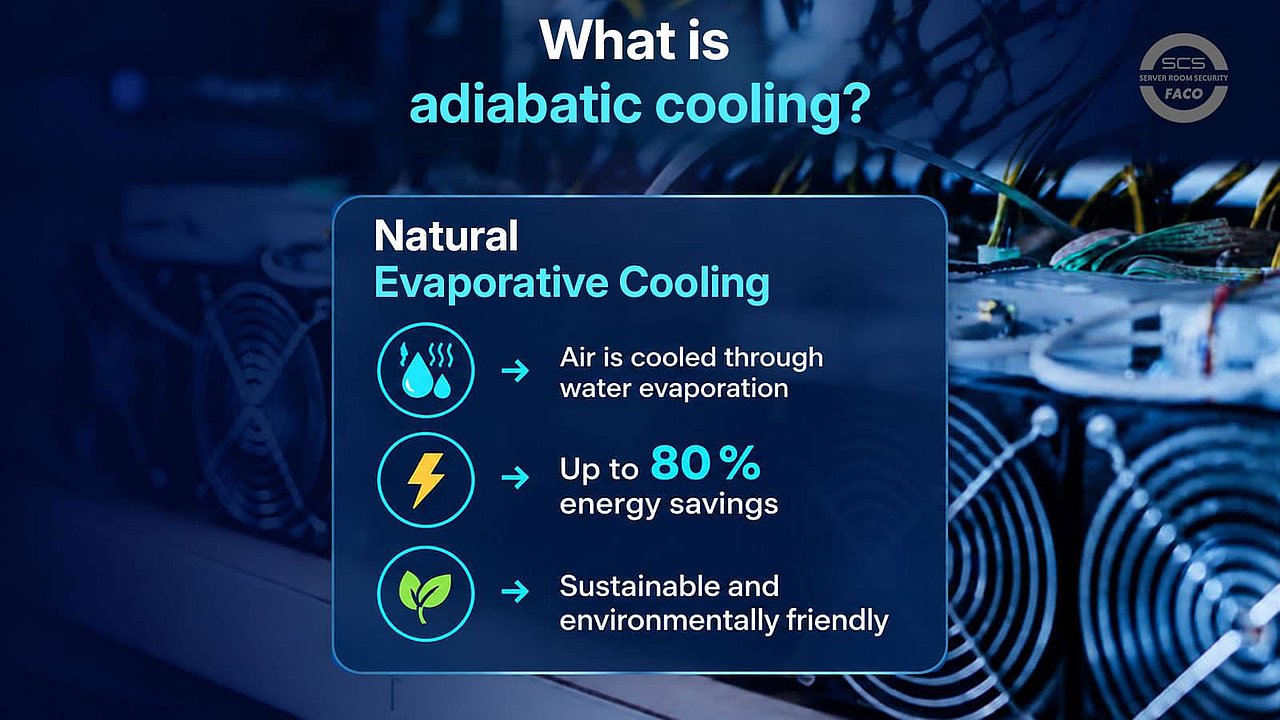
Adiabatic cooling is a method for air conditioning rooms . It utilizes the evaporative cooling effect of air and water as a source of cooling. This method is sustainable and efficient. The natural process of water evaporation provides 95% of the cooling capacity.
Adiabatic cooling is a thermodynamic process based on the evaporation of water to lower the temperature. Cooling occurs without external refrigerants through the evaporation of water in the air. At 99% saturation, adiabatic cooling consumes 27% less energy than conventional dry cooling. This is according to a study by the Department of Mechanical & Mechatronic Engineering at Stellenbosch University.
What is adiabatic cooling?
Adiabatic cooling is a form of evaporative cooling. In this process, air is cooled to a comfortable temperature through the evaporation of water. The resulting evaporation serves as the cooling source. Adiabatic cooling is an efficient and sustainable method for air conditioning rooms.
The water evaporation used in adiabatic cooling requires energy in the form of heat. This evaporative energy is drawn from the surrounding air. The effect of evaporative cooling is limited at high humidity levels because the air's evaporation rate is restricted. Adiabatic coolers are particularly effective in environments with low to medium humidity.
Adiabatic cooling is the most sustainable and environmentally friendly way to cool and ventilate production facilities, distribution centers, and office buildings. Cooling production and workspaces requires significant cooling capacity and incurs high energy costs. Using adiabatic cooling enables energy savings of up to 80% and is a much more efficient method for air conditioning servers than conventional air cooling.
According to refrigeration researcher Professor Rudolf Plank, the history of evaporative cooling begins in antiquity. The Egyptians used porous clay vessels to cool wine and water. The liquid evaporated on the outside of the vessels, cooling the contents. Egyptian frescoes from around 2500 BC depict slaves waving large fans over water jugs to cool the drinking water through evaporation. The concept of adiabatic condensation developed alongside the theory of gases and heat in the 19th century. The Scottish engineer and physicist William John Macquorn Rankine first used the term "adiabatic" in the second half of the 19th century to describe a change of state without heat transfer. Adiabatic cooling works according to a simple physical principle.
How does adiabatic cooling work?
Adiabatic cooling works through the physical process of water evaporation. The thermodynamic principle of evaporative cooling extracts sensible heat from the air, leading to a reduction in air temperature. This technology uses water as a refrigerant and operates without heat exchange with the environment.
The way adiabatic cooling works is based on a simple physical principle: the evaporation of water. Temperature reduction through evaporative cooling is a process that relies on the absorption of water vapor from the air. In vapor, water molecules move faster than in a liquid. The mobility of the water molecules is increased by absorbing heat energy from the surroundings. This creates the cooling effect.
The temperature reduction achieved through adiabatic cooling depends on the amount of water vapor released into the air. In cooling systems, outside air is passed through water-soaked pads, which cools the air through evaporation. This method allows for a reduction in air temperature of up to 15 degrees Celsius.
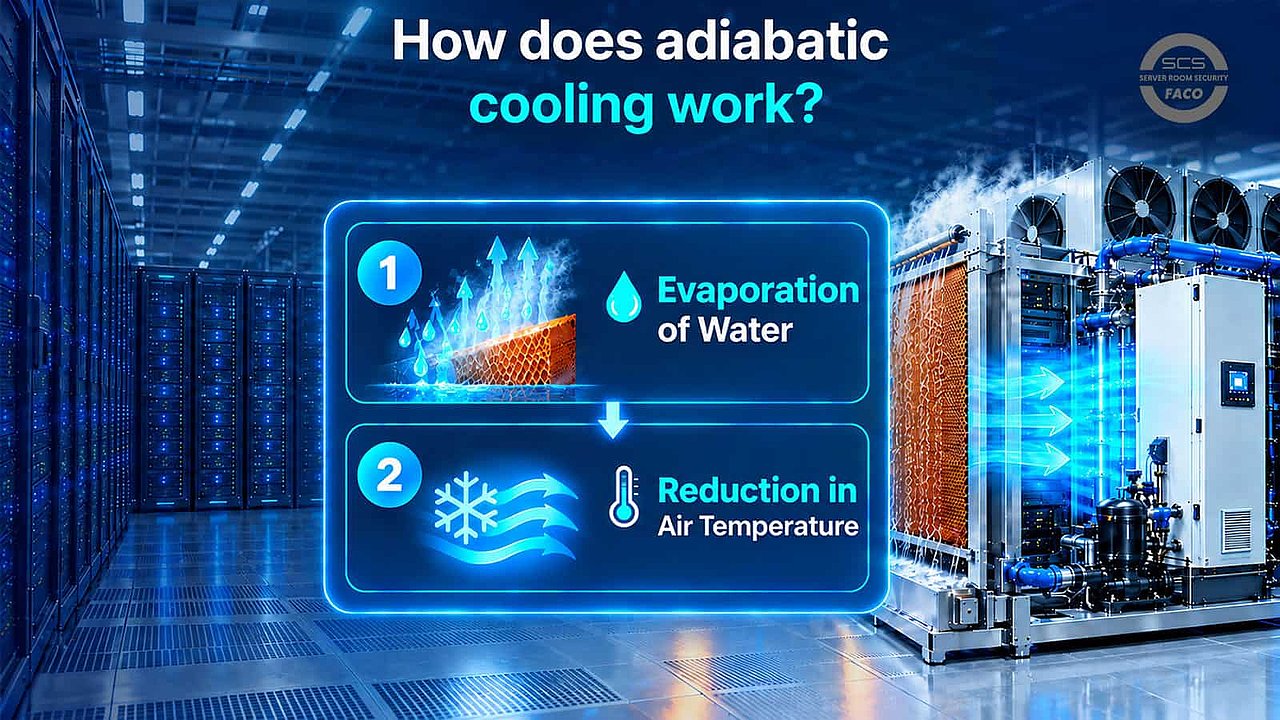
The process of adiabatic cooling primarily takes place in two steps.
- Evaporation of water: Initially, the air is humidified by introducing water, which is introduced into the air via spray nozzles or a humidifying mat. The water absorbs the heat energy from the air and evaporates.
- Reduction in air temperature: During evaporation, heat is drawn from the air, leading to a cooling of the air temperature. The evaporation of water requires energy, which causes the water vapor to be stored in the atmosphere. This results in a cooling of the air.
The term "adiabatic" means that no additional heat is added or removed, apart from the heat generated by the evaporation process. The total energy in the system remains the same, and the perceived air temperature decreases.
Adiabatic cooling is divided into direct and indirect cooling. In direct adiabatic cooling, the air is cooled directly through the evaporation of water. The air flows over a moist medium, causing water to evaporate and thus cooling the air. This process leads to an increase in the relative humidity of the cooled air, as the water is released directly into the air.
In indirect adiabatic cooling, cooling occurs without direct contact between the air being cooled and water. Instead, a heat exchanger is used, in which evaporation takes place in a separate airflow. The cooled air flows through a heat exchanger that transfers the heat energy of the warm air to the cooled air without affecting the humidity. This method of indirect adiabatic cooling reduces humidity by up to 60% and saves approximately 30% water. Certain fundamental thermodynamic quantities and methods are essential for the precise calculation of adiabatic cooling.
How is adiabatic cooling calculated?
Adiabatic cooling is calculated using an h-x diagram. The h-x diagram is a graphical tool for representing and calculating changes in the state of moist air due to heating, humidification, dehumidification, or cooling. These changes in state can be determined directly from the diagram.
In adiabatic humidification, water evaporates. Because evaporation occurs without a simultaneous heat input, the energy required for evaporation is drawn from the surrounding air. The air cools down. This cooling process is called adiabatic. In the h,x diagram, the precise direction of cooling during humidification can be determined from the boundary condition ∆h/∆x.
The h,x diagram shows all the essential parameters necessary to describe the state of the air.
| temperature | = t | in °C |
| Absolute humidity | = x | in g/kg |
| Relative humidity | = rF | in % |
| Specific enthalpy | = h | in kJ(1+x)kg |
| density | = p | in (kg/m3) |
The adiabatic humidification is calculated using the h,x diagram and the formula Δh divided by Δx. Δh is calculated from the components kJ divided by kg. To calculate Δx, the amount of water in kg and the amount of dry air in kg are required and divided.
Adiabatic cooling offers some advantages, but also has certain disadvantages.
Advantages and disadvantages of adiabatic cooling
Adiabatic cooling offers advantages such as improved air quality, energy efficiency, sustainability, and low operating costs, but also some disadvantages. Among the most significant drawbacks are a humid indoor climate, limited effectiveness in humid climates, and high water consumption for businesses.
What are the advantages of adiabatic cooling?
The advantages of adiabatic cooling include optimal indoor air quality and humidity. Conventional cooling systems recirculate and reuse stale, warm indoor air. Adiabatic cooling, on the other hand, uses only fresh, filtered outside air to cool a building or room.
The most important advantages of adiabatic cooling are summarized in the following list.
- Fresh air quality: In adiabatic cooling, the warm, stale indoor air is not recirculated, but replaced with fresh, filtered outside air. This significantly improves indoor air quality.
- Efficient energy savings: The use of adiabatic cooling achieves energy savings of up to 80%. Adiabatic cooling is capable of completely replacing the requirements of an air conditioning system.
- Environmentally friendly cooling performance: Adiabatic cooling is an environmentally friendly and sustainable technology. It consumes only 10% of the energy of conventional air conditioners. 95% of the cooling capacity is achieved through the natural process of water evaporation.
- Low operating costs: In adiabatic cooling, water is the primary energy carrier. No electricity is required for compressors. Due to the low energy consumption, operating costs are lower compared to conventional cooling systems. Adiabatic cooling can save over 80% of operating costs. Using adiabatic cooling saves primary energy and offers significant cost-saving potential.
In addition to the advantages of adiabatic cooling, there are also some disadvantages to this type of cooling to consider.
What are the disadvantages of adiabatic cooling?
Disadvantages of adiabatic cooling include a humid indoor climate and limited applications. During the cooling process, moisture is added to the air, making the cooled room feel damp. The most significant disadvantages of adiabatic cooling are summarized in the following list.
- Humid indoor climate: During adiabatic cooling, a significant amount of moisture is added to the air. This moisture leads to a humid indoor climate. If the humidity rises too high, working comfort is impaired and mold growth is promoted.
- Limited applications: Adiabatic cooling is particularly efficient in hot and dry climates. However, its performance decreases significantly in humid climates. This is due to the system's operating principle: it uses the evaporation of water to cool the air. In a high-humidity environment, however, the air can only hold a limited amount of moisture, thus reducing the cooling effect.
- High water consumption: A significant disadvantage of adiabatic cooling is its high water consumption. The system relies on the evaporation of water to cool the air. A constant supply of fresh water is essential. However, in water-scarce regions, this leads to problems and high costs, as the water demand places a heavy burden on available resources.
- Extensive planning: Installing an adiabatic cooling system requires careful planning to utilize airflow efficiently. Adiabatic cooling systems require a significant amount of water and space for evaporative cooling units, whereas conventional air conditioning systems rely on refrigerants and mechanical components. The costs of adiabatic cooling should be carefully examined beforehand.
How much does adiabatic cooling cost?
Adiabatic cooling costs approximately €0.35 per hour. The exact cost depends on various factors. Operating costs are determined by water consumption, while installation costs depend on the location and infrastructure. The size and performance of the server system to be cooled also influence the cost.
The average water consumption of adiabatic cooling systems is 50 liters per hour. At a price of €2 per cubic meter of water, this results in hourly operating costs of €0.10. The electricity is used to increase the speed of the electric pump that regulates the airflow. The electricity consumption for evaporative coolers is 1 kW per hour, resulting in electricity costs of €0.25/hour. The operating costs for adiabatic cooling systems average €0.35 per hour. The cost savings compared to conventional cooling systems are 80%.
The cost of adiabatic cooling varies depending on the size and complexity of the system, but is often lower than that of conventional air conditioning. The low energy costs make the system a cost-effective alternative. While the initial purchase price of an adiabatic cooling system varies, it is generally lower than that of conventional air conditioning. However, ongoing water costs must be considered and included in the operating costs.
A study by the Department of Mechanical & Mechatronic Engineering at Stellenbosch University shows that adiabatic cooling, with 99% saturation, consumes 27.09% less energy than conventional dry cooling. Adiabatic cooling is an efficient cooling method and offers many advantages over alternative cooling processes. Depending on the application and climatic conditions, other cooling systems should be considered.
Alternatives to adiabatic cooling: Cold aisle and hot aisle systems with components from SCS FACO
Cold aisle and hot aisle systems with components from SCS FACO are a modern and future-proof alternative to adiabatic cooling. The energy-efficient airflow and reliable air separation provided by cold and hot aisle systems guarantee stable cooling of server rooms without the risk of a humid environment.
Unlike water-based cooling systems that rely on evaporation, SCS FACO's hot and cold aisle containment systems offer stable temperatures through efficient airflow. Our hot and cold aisle systems increase cooling efficiency and reduce energy consumption compared to adiabatic cooling systems through targeted airflow. The cold aisle containment directs cold air precisely to the racks and maintains a constant temperature, thereby increasing energy efficiency. The cold aisle design guarantees a stable temperature level. The modular construction allows for individual customization at any time. Uniform air distribution throughout the cold aisle ensures energy-saving operation. Hotspots and warm air recirculation are prevented. The SCS FACO cold aisle containment is equipped with a transparent and protected CAC roof system made of Makrolon or Exolon. Its 150 mm height allows for simplified integration with existing fire protection systems. SCS FACO's CAC door systems, available at serverroom-security.com, ensure that warm air can only escape through the servers. The sliding doors of the cold and hot aisle systems are available in various versions, including self-closing, manually closing, free-running or synchronously running.
Compared to adiabatic cooling, SCS FACO's hot aisle containment significantly reduces energy consumption, as less cooling capacity is required to achieve the same temperature. Air mixing is prevented, hotspots are minimized, and uniform cooling is ensured. The system's modular design allows for flexible adaptation to server rooms. SCS FACO's hot aisle containment systems, available at serverroom-security.com, are manufactured using a HAC chimney design. The chimney elements are stackable and compatible with all rack systems. They are also available as a freestanding aisle solution for simplified server rack replacement. The hot aisle containment walls are made of coated steel, Makrolon, or Exolon. SCS FACO's HAC door systems keep the warm air contained within the hot aisle. The sliding doors, with safety glass or plastic panels, are available in self-closing or manually operated versions with free-swinging or synchronized operation.
More
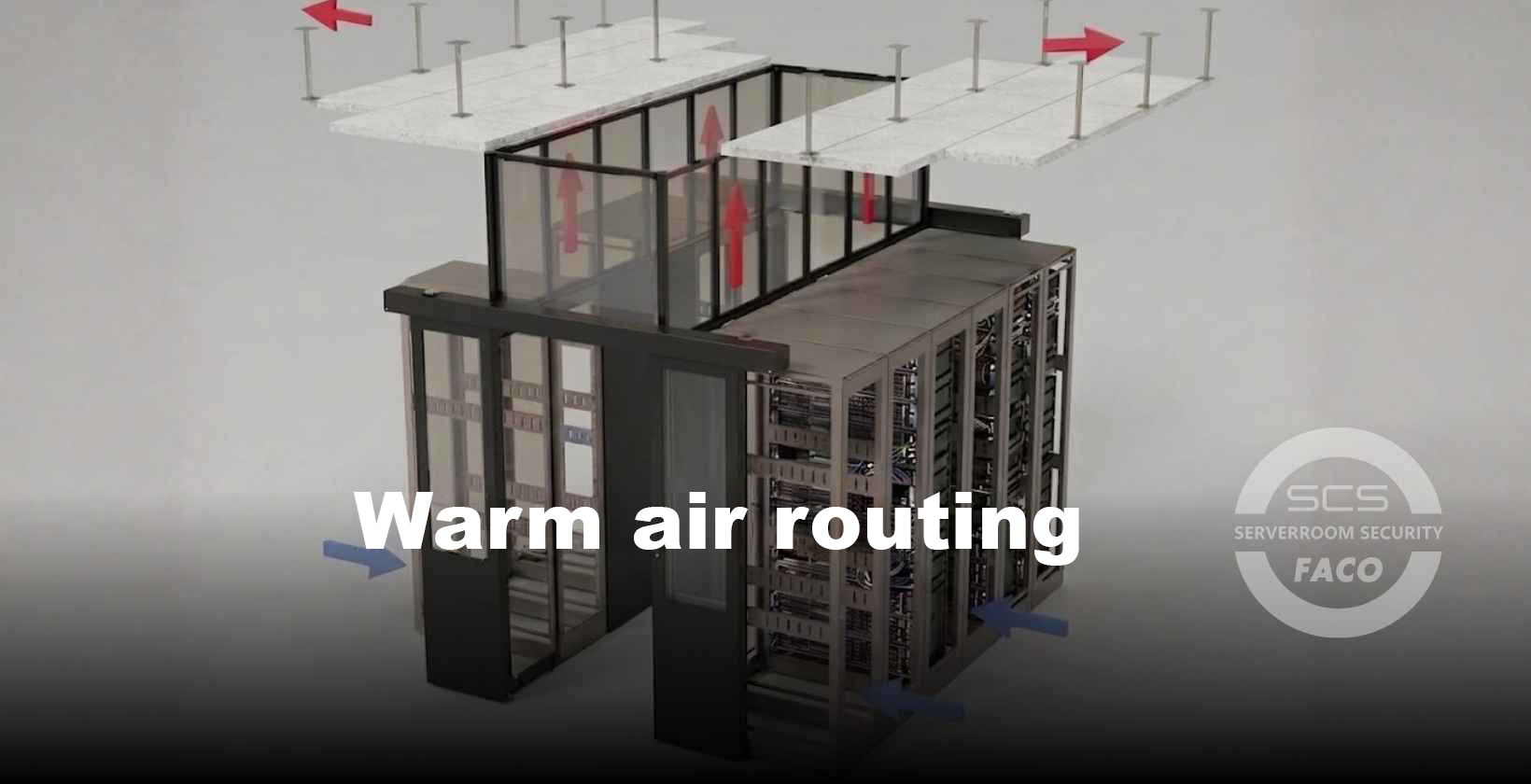
Warm air routing from SCS FACO
Warm air routing is an essential component of data center air conditioning with hot aisle and cold aisle systems. It ensures that the heat generated by servers and other IT components is dissipated in a controlled manner from the immediate rack area.
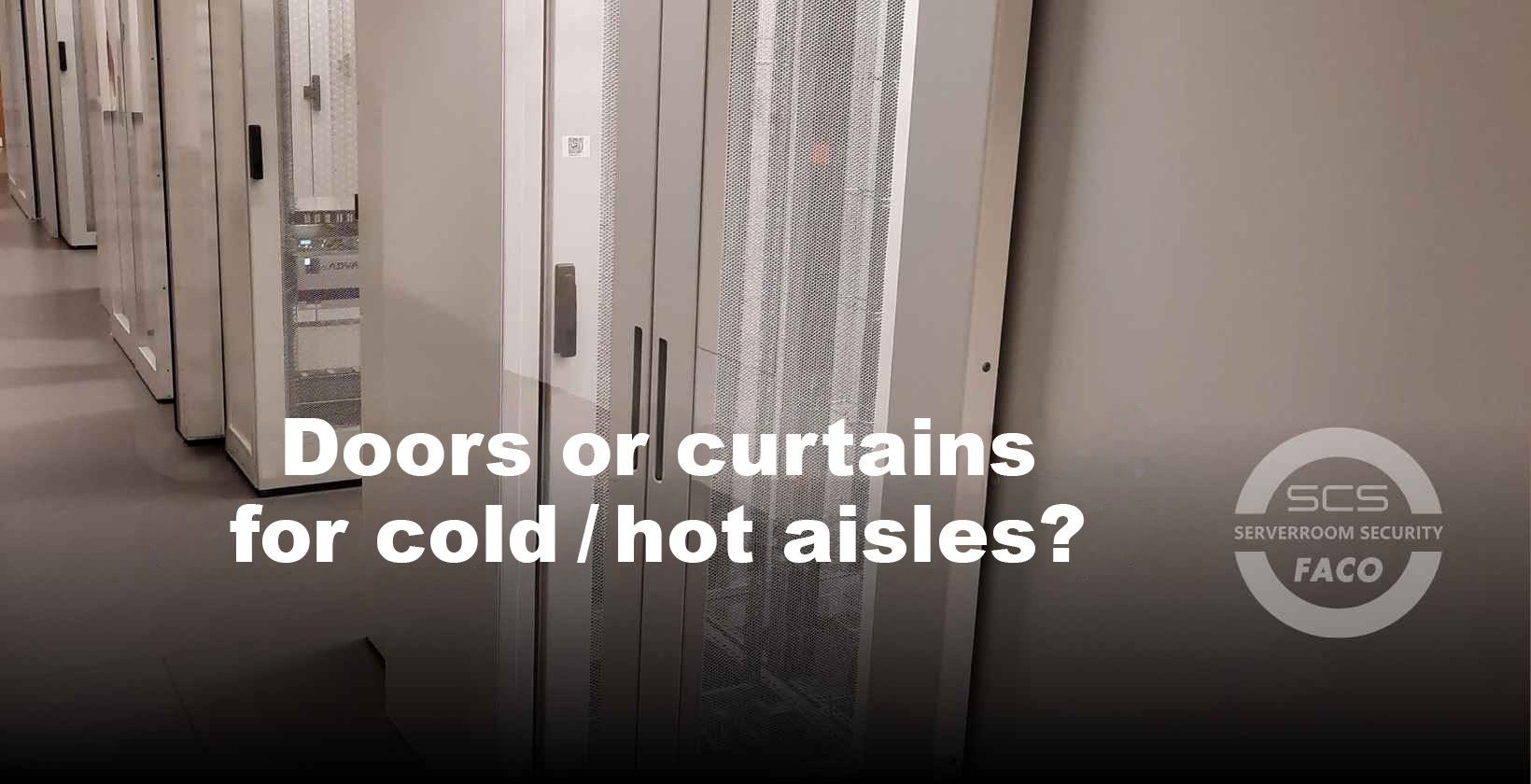
Doors or curtains for cold / hot aisles?
Whether doors or a curtain are more suitable for the cold aisle / hot aisle depends on the individual room conditions and framework within the server room.
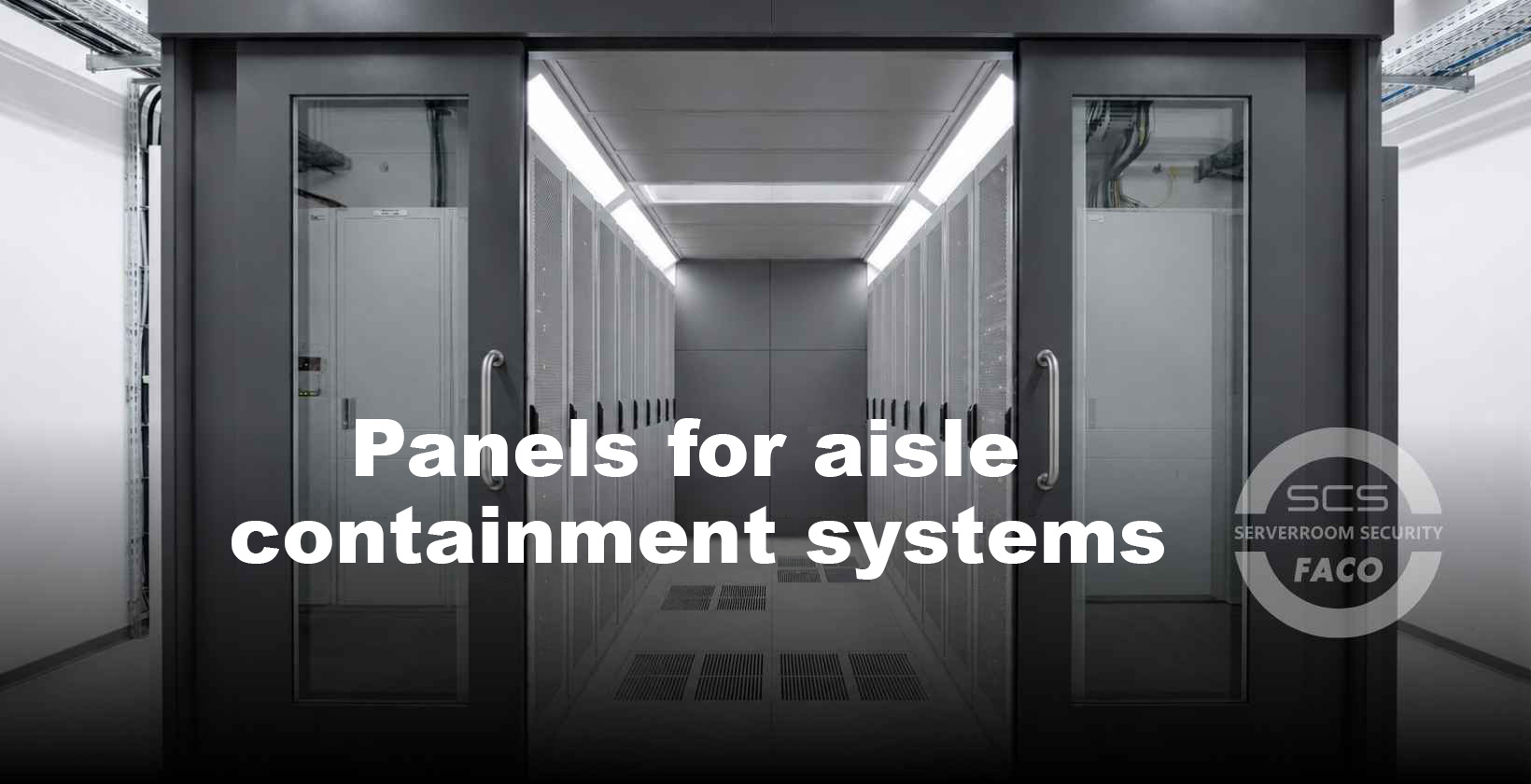
Panels for aisle containment systems from SCS FACO
SCS FACO's aisle containment panels are modular in design and can be individually adapted to existing or planned rack systems.